Saturday, December 29, 2012

All-Purpose Cleaner with Love

I don't even remember when I started using nontoxic cleaners.  I was using them unconsciously as I grew up as my mother used them.  She may have been using them to save money.  After all, she had five kids to raise, and a gallon of vinegar is a lot cheaper than a manufactured product.

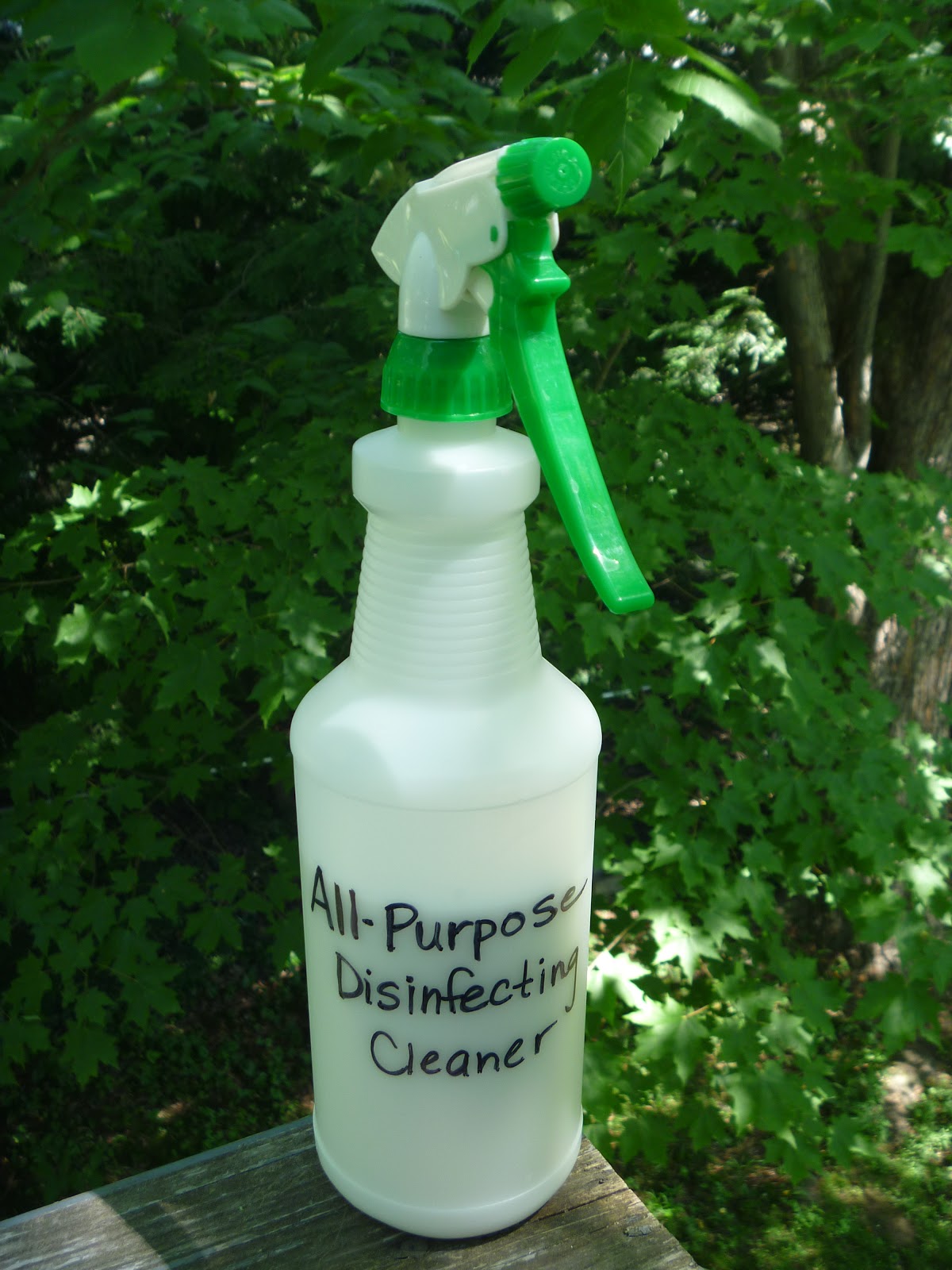
When you make your own cleaners, you should always start with a clean container.  If it's a previously used container, make sure you don't have residue from the previous contents still in the container when you put it to reuse.  Clearly mark your container so you don't confuse it with something else.  Just take a sharpie, permanent maker and write on the container.

For my all-purpose disinfecting cleaner, I use a spray bottle that can be purchased in the gardening section of many stores.  The nozzle is adjustable to regulate a misting spray to a straight shot.

I have been cleaning my apartments with a nontoxic, home-made cleaner for many years.  It's very simple and the recipe follows:

All-Purpose Disinfecting Cleaner
1 tablespoon liquid soap
1 cup warm water
2/3 cup white vinegar

In a spray bottle, mix the soap and water first to prevent clumping.  Then add the vinegar and mix gently. 

Why Use a Home-Made Cleaner?

When you make your own cleaner, you really, really know what's in it.  When you buy a cleaner, you can't be sure all of the ingredients are listed.  The U.S.  EPA gives a warning about commercial all-purpose cleaners:

       When using [commercial] all purpose cleaners, follow these safety steps:

  • Wear rubber gloves to protect your skin
  • Be sure that there is good air circulation in the room. Open several windows or keep a fan running.
  • NEVER mix two cleaners of different kinds together, especially if one contains ammonia and the other contains chlorine. This can produce a gas called chloramine, and breathing its fumes could be fatal.
You could buy a commercial cleaner containing bleach to kill germs, but white vinegar also kills germs.  So, why pay more for a cleaner that can harm you?  Just make your own.


Thursday, November 15, 2012

Just a Few (of the many) Things I Didn't Know

I live on the border of New Hampshire and Vermont where there are several e-mail list serves to connect residents who have lost a dog, want to sell a dresser, or share whatever information they choose.  After seeing an e-mail from someone saying, "Dishwasher Now Runs Clean: Want to THANK whoever it was that suggested putting a 1/2 cup of white vinegar sitting on the top shelf in the dishwasher.  That has made all the difference in the world!   I now buy the vinegar by the gallon."

I actually never saw the original e-mail and I've never owned a dishwasher, but it was gratifying to read that vinegar once again had saved the day in someone's home.  Less money, less toxic output.

I then decided to see what else people in my area know about nontoxic cleaners, so I put out this notice on three local list serves:  "If you have any recipes or experiences with nontoxic cleaning, I'd love to hear them."

Well, I received many responses.  Most were ones that are already addressed on this blog either in the posts or on the Recipes page.  But again, it was great to hear that other people are using simple, nontoxic recipes to clean their homes.

There were a few recipes I had never heard before--and I'm sharing them below.

Weed and Grass Killer

"Pour straight white vinegar on the weeds to get to the roots, but don't get it on anything you want to keep."

I sent out an e-mail to a group in a Household Hazardous Waste Committee and received a confirming response that vinegar actually kills weeds!  My friend, Joanne said she had her granddaughter spray a section of weeds growing up in her gravel driveway.  They had to do it twice as the weeds were thick and well established, but she lives on a lake so it's great she found a non-toxic way to kill weeds.

Photo Credit Link

Fruit Fly Trap

"Put about an inch of apple cider vinegar into a small jar with a little water and a drop or two of liquid dish washing liquid.  The fruit flies will be attracted and drown in the liquid...you'll have to dump it out and make a fresh batch every now and then if you have a lot of fruit flies."

I'm not sure what the point of the dish washing liquid is, but who can argue with success.  Personally, I just use my kitchen compost can and put the lid on it to trap the fruit flies.

Tub and Sink Cleaner

"A mixture of Borax and Dr. Bronner's Sal Suds is very effective, good smelling, and makes everything shine."   

Saturday, October 27, 2012

Ode to Vinegar

Oh white vinegar,  how do I love thee, let me count the ways....  If ever there was a multipurpose nontoxic product, it is white vinegar.   It is used in cooking, gardening, health remedies, automotive cleaners, air fresheners, laundry cleaning, and general all-purpose household cleaners.  Visit Vinegar Tips for a more thorough explanation of the 1001 uses of white vinegar.

White vinegar is made by allowing a distilled alcohol to undergo acid fermentation. The typical store-bought white vinegar is 5% acetic acid which makes it a great cleaner.   Michael Mullen of the  Heinz Company referred to several studies to show that vinegar has properties to destroy 80% of viruses, 82% of mold, and 99% of bacteria.  Thus, as it should be, vinegar is a common household product used for cleaning bacteria laden surfaces like kitchen stoves, toilets, sinks, and floors.   Vinegar is a much better option than the chemical cleaners available in stores as vinegar does not have the harmful health effects of most commercial cleaners (read the tiny print on the labels for a good scare).


Personally, I use vinegar in a homemade all-purpose cleaner made with white vinegar, liquid soap, and water (see the Recipes page of this blog).  For an air freshener, I put a bowl of white vinegar on the counter.  (I do this with baking soda as well.)  I use vinegar as a toilet bowl cleaner by pouring straight vinegar into the toilet bowl, scrub the toilet with a brush, and let is sit until the next use of the toilet.  I use simple vinegar and water to mop the linoleum kitchen floor as well as the bathroom floor.  Vinegar and water can be sprayed on to windows and mirrors, then wiped off with crumpled newspaper for sparkling glass.  Oh, white vinegar, how do I love thee....

The last time I bought vinegar at the local grocery store, it cost me less than $3 for a gallon.  That's a lot of cleaning power for less than three bucks.


Give vinegar a try in cleaning your home.  It's cost-effective, it works, it kills the microbes you want to kill without causing you and your family harm.  The smell is much more appealing to me than commercial cleaners especially realizing when I smell those cleaners, I'm inhaling toxic fumes.  Add several drops of your favorite essential oil to your vinegar cleaner if you'd rather smell peppermint or citrus.


Go forth with the rightly esteemed white vinegar....


Photo Credit Link 

Friday, October 19, 2012

Hidden Time Bombs in Schools

For over a week, I was at a conference on household hazardous waste in Los Angeles, California.  It turns out, I am definitely not an L.A. girl.  I arrived back home to Vermont, and I am relishing the chill of the oncoming autumn.   The conference was put on by the North American Hazardous Materials Management Association (NAHMMA).  It was excellent!  They did a fabulous job--especially the discussions about hazardous products in public and private schools.  Products are found throughout the schools in chemistry labs, art classrooms, and maintenance closets.

Chemistry Labs  

I already knew chemicals in labs were  a problem (because I'd watched a webinar by NAHMMA).  But it absolutely fascinates and horrifies me that outdated and unknown chemicals found in  schools can cause fires, explosions, spills and toxic human exposure. These incidents from poorly stored chemicals present a risk to children in addition to thousands of dollars in cleanup costs. 

These may be products that are currently in use, but also ones that are languishing behind other bottles of laboratory chemicals--waiting, just waiting for something bad to happen.  Those bottles have often been there for decades.
Picric acid really intrigues me because it is sensitive to sudden movement, heat, or friction.  So, if someone were to say drop a bottle of picric acid in the high school laboratory, there is potential that it could blow out the room.  Here's a YouTube video of an detonation of just 14 grams of pitric acid.  Imagine if there were a jar of this in the school!  (Pitric acid also intrigues me because they used to put it in vaginal suppositories.  What were they thinking?)

An ethyl ether YouTube video shows a violent explosion of another common chemical found in schools.  I guess a good chemistry laboratory may need some dangerous products to teach, but many schools overbuy or hoard dangerous products.  And with teachers leaving and new teachers coming in, the toxic load can increase.

Schools may or may not realize what they have.  Some schools go so far as to do a chemical inventory and obtain a cost estimate to get rid of these products from the school, but when they find out how expensive it is (it could be $4,000 for just one bottle of something especially dangerous), they leave it all where it sits.   So it's back to out of sight, out of mind--and the disposal cost is not going to go down by pretending those chemicals are not there. 

Schools have budgets like everyone and chemical disposal can be very expensive.  A "triage" might help the schools select the most dangerous chemicals to get rid of first so they don't bust the annual budget.

King County, Washington provides a Rehab the Lab program to help schools sort out their chemicals and keep the labs safer for kids.  They also provide lab safety videos.

Art Classrooms

Oil paints, pastels, acrylics, charcoal & graphite dust, markers and inks, spray adhesives, and clean-up solvents are part of the artistic and sometimes toxic potpourri in the art classroom.   

Art supplies can be so dangerous that the  California and Illinois  have legislation to limit toxic art supplies in schools.  They recognize that children cannot read the labels of products to see what they should be exposed to or not.  Paints and other art supplies can produce some of the most eloquent and thought-provoking art, but they can also be carcinogenic or cause allergic reactions while the artist is making her beautiful creations.

Photo Credit Link 

The U.S. Environmental Protection Agency provides guidance in purchasing nontoxic art supplies as does the Art and Creative Materials InstituteKing County, Washington provides great information on art supplies and selecting less toxic alternatives.


Maintenance

There are a lot of kids tramping through the school and going in and out at recess.  The cleaners tend to be more "heavy-duty" or toxic than at home.  But these cleaners do not have to be so toxic that they cause health problems such as aggravating or even causing asthma. 

For maintenance and other cleaning products, schools have resources such as the Green Schools Initiative, Cleaning for Healthy SchoolsGreen Clean Schools, and  The Environmental Working Group.  There are many web sites and resources for schools to green up their act and clean with nontoxic cleaning products that are not hazardous to children's health.

Photo Credit Link  

General Resources for Change

The U.S. Environmental Protection Agency recognizes these problems and has developed the Toolkit for Safe Chemical Management Program. You can also check out the Green Schools Initiative

We can keep the kids safe while providing a good--and healthy education.


Thursday, August 30, 2012

Nontoxic Fingernails

Today, I had a message at work from a woman asking if she should put her fingernail polish in with her husband's hazardous waste pile to take to a hazardous waste collection.  I called her back and told her that most nail polish is hazardous and that yes, she should add it to the pile.

I had nail polish on my list of articles to write for this blog, and the call this morning has spurred me on to write about nail polish and nail polish removers.

Nail Polish

I don't paint my nails very often, but when I do, I try to use a non-toxic polish.  I say "try" because in April 2012, the California Environmental Protection Agency published results of testing they did on reportedly "nontoxic" nail polishes to find that many of them are indeed toxic.  The story was picked up by ABC, CBS, and NBC networks.

The California Agency bought 25 products and sent samples to an independent lab to text for the "toxic trio" often found in nail polishes: dibutyl phthalate, toluene, and formaldehyde.  Dibutyl phthalate is absorbed through the skin and can cause developmental defects of fetuses, especially males.  Toluene can cause occupational asthma.  Formaldhyde is a probable carcinogen.  No wonder nail polish is so stinky.  Imagine painting people's nails for a living.  Not a healthy profession, and those paper masks aren't going to help.

What the Agency found from the tests is that some of the nail polish with labels that claimed the product to be "nontoxic" contained at least one of the toxic trio.  And some of the products that did not make any claims to be nontoxic, were actually nontoxic with none of the toxic trio.  So, there is no telling what is in the nail polish without accurate labeling requirements. So, once again, we are buying unregulated products that can be harmful. 

Nail Polish Remover

And then you have to take the polish off at some point.  I once had a pedicure and the nail polish lasted for over a month until I got sick of it and removed it.  My nails didn't look very good after being deprived of oxygen for so long, and the remover really stunk.  I actually used polish remover once to clean a part on a car--I can't remember the details now, but found that it worked quite well.

Most nail polish removers are highly toxic containing acetone.  Acetone poisoning
symptoms are described in a National Institutes of Health document including lowering blood pressure, nausea, vomiting, sweet taste in the mouth, acting as if drunk, difficulty breathing, among many other symptoms.

A common alternative, which is also hazardous due to its flammability, is ethyl acetate.  The US EPA considers it to be relatively nontoxic even though it can cause vomiting, headaches in large amounts.  I suppose vodka could have the same effect.  Hmmm...is vodka a hazardous product?  That could be another post another time.  Choose your poison...preferably vodka to nail polish remover, I think!

Nontoxic Alternatives

Check out various nail polish and removers products at the Skin Deep cosmetics database.   I do know of some supposedly nontoxic nail polish brands that are not on this database.  In my bathroom, I have Peacekeeper and Sante polishes and Suncoat nail polish remover.  The Sante and Suncoat nail products on not in the database.  The Peacekeeper nail polish (2006 formula) does not sound good.  I bought this one more recently so, again, I don't know what's in it.

On the Peacekeeper web site it says, "Rated by the Environmental Working Group as the Safest Paint-Based Natural Nail Polish! Natural Nail Polish at its best! The Environmental Working Group's Cosmetics Safety Database (www.cosmeticsdatabase.org) has independently rated our Eco-Smooth Nail Paints on a scale of 0.0 (for nontoxics like water) and 10 (for products with the highest toxicity). Our polishes, at rank 3, are the highest rated paint-based nail polish.  AND they're 100% Vegan! Who could ask for anything more?"

Well, I could ask that they update their website because I don't find that information on the Skin Deep cosmetics database.  And there are nail polishes in the database that rank at "1" or "2" in toxicity which is lower than Peacekeeper.  And the Peacekeeper I do find is rated as a "4."

You could just eliminate nail polish and removers from your life--and go green.  Your nails will be healthier and your indoor air quality will improve.  Naked nails can be sexy.  Check out this article on buffing.

Monday, August 13, 2012

Teen Angst & the Pharmacy

Prescription drug availability is a real problem.  We keep our drugs on the counter, in the kitchen cupboard, on the dresser, on the night stand, in the medicine chest....  This may be quite a temptation to someone in your household, especially teens.  (Those people that are between childhood and adulthood are going through incredible physical, mental, and emotional change and turmoil.) Would you notice if a few of your pills were missing?  Maybe there are old prescriptions you've saved that you're not using anymore.  Do you know how many pills are in the bottle?  Is there a prescription that you only use when you're in pain and not on a regular basis?  Do you know how many pills are in that bottle?

I think I told you how old I am in the first post, but in case you've forgotten, I'm 54--still.  And since I am a dinosaur, I feel comfortable (well, almost) telling you about my teen years which were a very long time ago, but memorably less than stellar.

I used to be incredibly depressed as a teen.  There are things about my teen years that I don't fully understand even now, but somehow cutting myself with a razor on my wrists put me in control of all the pain.  I was in my mid-teens, maybe around 14 or 15.  School was difficult, relationships at school were difficult, there was peer pressure to have a boyfriend and have sex, and there were abundant drugs available.  Smoking pot during the school lunch hour was very common, and it was out in the open.  Pregnancy looked like a contagious disease, and the adults were not responsive to a request for sex education.  I can still think of at least 10 girls who were pregnant during my tenure at high school in northern New Hampshire.  It was a relatively small school.  I think there were about 60 kids in my graduating class, so the percentage of pregnant girls seems very high to me--and those were the ones I knew about. 

All the cool kids would go to the high school dances across the river in Vermont.  And by "cool," I guess I mean the ones whose parents were clueless or had raised their kids to be more responsible than I was.  My parents were clueless.  I was not a bad kid, I was unhappy, and I wanted to feel better.  I don't remember kids using prescription meds then.  We were more into the over-the-counter meds like No-Doze for an upper and liquid cough medicine for the alcohol.   How stupid, you say?  Well, yes, this is the point.  But we didn't care!  Pop some over-the-counter pills?  Sure, why not.  Life is so boring/confusing/traumatic, why the hell not? At the Vermont dances, there was a lot of activity in the restrooms and the parking lots getting high. 

My parents let me go to the dances because my best friends' father would take us and pick us up.  What my parents didn't know and I never told them is that Mr. X was usually a bit wasted himself with alcohol.  It seemed like everyone was trashed, so why would it feel like a problem?

I'm telling you some of the gory details of my youth to make a point.  And I hope that you, reader, will consider your past and the confusion you may have experienced in growing up.  The teenage years are tough!  They can be really tough.  I'm not a parent, so I can't preach at anyone about parenting, but there seems to be a huge problem about kids and drugs.  I'm not even talking about the illegally produced street drugs, but the ones in your medicine chest. 

So conjure up your teenage angst to help you relate to the following.

Pharm Parties

My nephew being a great sport to pose.
How about some trail mix?  No, not that kind!  OK, how about some Skittles?  The recipe for either is to steal prescription drugs from someone's medicine cabinet (easiest to get your parents' drugs -- they won't notice), then go to a pharm party where all the other kids have done the same thing, take the drugs out of their labeled containers and dump them into a bowl and mix.  Now, grab a handful and wash them down with an alcoholic beverage.  Adderall, Xanax, OxyContin, Vicodin, morphine, whatever....  Trashed, baby, trashed.  Just not the painful normal. 

Oh my gosh, now imagine you're the ER doctor who gets one of these kids who is unconscious and foaming at the mouth.  If you knew what the kid had taken for a drug, maybe you'd know what to do.  But you have no idea--it was a "pharm party" with any prescription drugs they could get hold of.  What do you do?  Damn!  Or maybe you're lucky, and it was a kid who was more savvy about which drugs gave her the high she was looking for and you can find out what she had access to at home or school.  Have a look at this clip from The Drs.

While there has been a marked decrease in the use of some illegal drugs like cocaine, data from the National Survey on Drug Use and Health show that nearly one-third of people aged 12 and over who used drugs for the first time in 2009 began by using a prescription drug non-medically.  Check out this ABC News Report video from 2010 on pharming and prescription drug addiction in teens.

And This is My Problem How?

If you live alone and no one has access to your home and therefore your prescriptions, maybe you're just fine.  But if you live with others, in particular those people who are going through hormonal changes, are moody, think you're stupid, and are just generally not having fun, not really, then you should be locking up your medicines and keeping track of how many pills you have.  Yeah, you locked them up, but teenagers are tenacious about getting what they want.  Do you remember?  I remember.  Make sure you do a really thorough job of locking them up.  You don't leave a loaded gun lying around.  Don't leave your drugs lying around either. 

And yeah, you should talk to them about this.  I wish someone had talked to me, but I think I scared my parents so badly that they just watched my downward spiral from afar wishing they knew what to do and just hoping it would pass.  

Dispose of Unwanted, Unused, or Expired Medicines

If you have prescriptions that you no longer need or that have expired, dispose of them properly so they're not a temptation.  First, find out if there is an unwanted medicines take back program in your area.  There have been a few national take-back events in the last couple years.  Have a look at the Federal Office of Diversion Control web site to see if your town is participating.  The next collection is on September 29, 2012 from 10 am to 2 pm.  Who knows how many more collections will be provided if any.  The feds are trying to figure out a more efficient method of collecting unwanted medicines so we'll see.  Also contact your local pharmacy, your town office, your police department, your regional planning commission, or your solid waste management district to see if they have information about a collection.  Check out Dispose My Meds on-line to see if there is a pharmacy near you that has a meds take back program.

Do not throw meds down the drain or down the toilet.  Those drugs end up in our drinking water!

If there is no collection, mix liquid meds with something dry and throw it in the trash.  It's recommended that meds be combined with something disgusting like used kitty litter so no one will want to pull it out of the trash.  I don't have the mind-set of a drug addict, but I've read this so many times, I have to assume there is valid purpose to doing this.


"What is happening to our young people? They disrespect their elders, they disobey their parents. They ignore the law. They riot in the streets inflamed with wild notions. Their morals are decaying. What is to become of them?"
Plato, 4th Century BC

Hmm...Guess it is biological.  Have pity.

Friday, August 10, 2012

Is Your Home Safe for Children?

You want to provide a clean home for your children.  You use cleaning products that promise all kinds of benefits like killing 99.9% of all germs while making your home smell like a tropical jungle.  All surfaces will sparkle, your kids' clothes will be ultra-clean, spot-free, and fragrant.  It sounds great, but is it really? 

Most common household cleaners are harsh.  They can cause all kinds of problems: laundry detergents can cause skin irritation; cleaning product fumes can cause indoor air pollution which can cause airway problems and irritate eyes; the chemicals that make the lovely fragrances have possible links to disrupted hormone levels; and some cleaning products can kill you or your child if used improperly.

Chemical companies are not required to include all ingredients on their cleaning product or air "freshening" labels, and most products have not been thoroughly tested for human health impacts.  However, there are words to look for:  "Caution," "Warning," "Danger," "Poison," and "Keep away from children and pets."

In addition to the indirect dangers of cleaners, many children have been poisoned by sampling these products.  In 2010, U.S. poison centers answered nearly 2.4 million calls about human exposures to poisons.  In children, about 40% of poisonings involve medicines; the other 60% involve products such as plants, cleaning supplies, cosmetics, pesticides, paints, and solvents.  Poisoning is the fourth leading cause of death among children with peak incidences in children between the ages of one and three.  About half of all poison exposures occur to children under the age of six.

According to the Center for Disease Control, every day, over 300 children in the United States ages 0 to 19 are treated in an emergency department, and two children die, as a result of being poisoned. It’s not just chemicals in your home marked with clear warning labels that can be dangerous to children.   It includes the everyday toxic products we purchase and don't think of as hazardous such as cleaning supplies

What Can You Do?

Make sure your cleaning products and other poisons are not accessible to your child.  REMEMBER, many poisonings occur when a product is in use and the parent is occupied with cleaning or when the parent is cooking a meal.

Switch your cleaning products to low or nontoxic cleaners.  There are many cleaners on the market that are much safer--however, beware of "greenwashing" of products.  Some companies use words like "natural" and "nontoxic," but do not prove it on their labels.  Make sure the product states that all ingredients are listed, and you understand what those ingredients are.

These products are pricier, but they may be worth it to a busy parent.  You may want to consider making your own, simple cleaning products with white vinegar, baking soda, and liquid soap (see the Recipes page on this blog).  They take just minutes to make.

When You Have Hazardous Products In Your Home

The Center for Disease Control suggests:

Lock them up. Keep medicines and toxic products, such cleaning solutions, in their original packaging where children can’t see or get them.
Know the number. Put the nationwide poison control center phone number, 1-800-222-1222, on or near every telephone in your home and program it into your cell phone. Call the poison control center if you think a child has been poisoned but they are awake and alert; they can be reached 24 hours a day, seven days a week. Call 911 if you have a poison emergency and your child has collapsed or is not breathing.
Read the label. Follow label directions and read all warnings when giving medicines to children.
Don’t keep it if you don’t need it. Safely dispose of unused, unneeded, or expired prescription drugs and over the counter drugs, vitamins, and supplements. To dispose of medicines, mix them with coffee grounds or kitty litter and throw them away. You can also turn them in at a local take-back program or during National Drug Take-Back events.

Note, these national programs will probably disappear when the federal government finds a better solution--which I hope will be soon.  Never pour medicines down the drain or flush them down the toilet.  They end up in our drinking water as treatment facilities and septic systems do not remove them.

There may also be a household hazardous waste collection in your area for the toxic products you have in your home if you're not going to use them.  Call your town or the solid waste management district to find out.