Showing posts with label vinegar. Show all posts

Tuesday, October 15, 2013

Clean Non-Toxic Oven


I finally cleaned my oven after about five years--I am just not that into cleaning.  I had help.  It was a few weeks ago and I wanted to make a video about cleaning the oven without toxic commercial cleaners.  So my co-worker Rachel and I cleaned the oven after finally settling on a recipe to try.  There are others that might work as well, but this worked great--so I'm going with it.  We mixed about a cup of baking soda with enough white vinegar to make a paste to stick on the ceiling and walls of the oven.

First, Rachel scraped out the oven with a wooden spatula to get ride of the crusty stuff that had accumulated there.  A wooden or plastic tool will not scratch oven surfaces like metal might.  Then she mixed a cup of baking soda and about a quarter cup of white vinegar.  I thought there might be a lava overflow when she did this on camera, but she chose just the right size bowl.

I think mixing baking soda (a base chemical) with vinegar (an acid) only makes sense when you use the chemical reaction as part of the cleaning process.  These ingredients quickly kind of cancel each other out unless you get them onto the surface as soon as possible so the reaction is still occurring.

Rachel took a pastry brush and painted the interior of the oven.  She had to get back to work, so I cleaned the oven after a couple hours with a green scrubby and water.  It worked great.  There was all kinds of black goo that came off--cooked on grease.  I cleaned the oven racks separately in the sink.

So after about several years of not cleaning the oven--it was clean, without using the very toxic commercial cleaner.

Unfortunately, this week I had a hankering for crispy baked chicken wings.  The recipe said to dunk the wings into seasoned olive oil and place them on a rack over a pan.  They tasted fantastic.  They were so crispy and good, but I did not need all that oil that ended up all over my clean oven.  It also stunk up my apartment as the stove vent does not send air outside, it just circulates the air through a filter.  Everything smelled like baked chicken wings and I was breathing the odor in my sleep.

So I was back to square one, and I just finished cleaning the oven again.  This time I put a pillow on the floor for my poor knees while I slaved away on the oven.  While I had my head stuck in the oven, I was thinking that people without the self-cleaning ovens have to do the same thing--only they stick their heads into an enclosed space with toxic fumes.

What's Wrong with Commercial Oven Cleaners?


This label reads, “DANGER:  CORROSIVE. CONTAINS SODIUM HYDROXIDE (LYE).  WILL BURN EYES AND SKIN.  HARMFUL IF SWALLOWED.  Avoid contact with eyes, skin, mucous membranes and clothing.  DO NOT ingest.  Use only with adequate ventilation.  Avoid breathing spray mist.  Wear long rubber gloves when using.   

The U.S. EPA also recommends wearing an apron and protective goggles when using commercial oven cleaners.  They further recommend having plenty of fresh air as well as ventilation in the room.  Difficult to do if you have your head in the oven!

The ingredients are not provided on the label, but on-line they are listed as:

2-Ethanol, (2-butoxyethoxy), Petroleum gases, liquefied and sweetened; Sodium hydroxide, and 2-amino-Ethanol 

Why Not Just Use the Self-Cleaning Function on Ovens?

There are pros and cons to buying an oven with the self-cleaning function.  They are much more well insulated and the doors have better seals so they may be more energy efficient if you don't use the self-cleaning function too often.  However, they can be more expensive to repair (due to hidden elements) and typically, you are not supposed to leave the racks in the oven for cleaning as the high heat (around 900 degrees F) can damage a finish on the metal racks.  You also might still have to clean the oven after using the self-cleaning function to at least remove the ash.

Well, I'm going to be more conscious about what I bake now, and I don't anticipate cleaning the oven again for a very long time.


Saturday, June 29, 2013

The Dang Drain is Clogged

I went to a neighborhood picnic tonight.  It was great, but when I got home to clean up, the sink backed up--almost up to the level with my clean dishes.  Really gross!

It was late, but who wants to deal with disgustingness in the morning?  Not me.  I knew my old standby of baking soda and vinegar followed by boiling water was not going to do the trick alone.  And there is NO WAY I'm going to use the commercial drain opener that can actually cause blindness if you get it in your eyes.

So, I remembered my landlord using a trick with a plunger in the sink.  (And I googled it to make sure I knew what I was doing.  See WikiHow.)  I have a double sink, so I checked which sink seemed to be the problem by poking a wooden skewer down each drain.  The one on the right was just fine, but the one on the left was clearly plugged up badly which called for drastic measures.

I put the drain plug into the right sink (wearing rubber gloves--really nasty water), then I used the plunger on the left sink.  The plug in the right sink still let water come up as the seal must not be very tight.  It took a couple tries, but I did get the left sink to drain properly.  I followed this with a dump of baking soda down the drain, followed by the vinegar to create a lovely volcano effect.  I left this for 5-10 minutes and followed up with a boiling water chaser.

My sink is just fine, thank you very much--without using something toxic and absolutely dangerous off the grocery store shelves.

NOTE; That is not an electrical cord in the photo, it's for my water filter which is NOT electric.  Just didn't want you to think I was playing with electricity in the water as my co-worker pointed out!


Water back-up in double sinks
Stick test to determine which sink is clogged
Using plunger in hot water in left sink
Adding baking soda


Adding vinegar after baking soda
Still foaming after several minutes


Saturday, October 27, 2012

Ode to Vinegar

Oh white vinegar,  how do I love thee, let me count the ways....  If ever there was a multipurpose nontoxic product, it is white vinegar.   It is used in cooking, gardening, health remedies, automotive cleaners, air fresheners, laundry cleaning, and general all-purpose household cleaners.  Visit Vinegar Tips for a more thorough explanation of the 1001 uses of white vinegar.

White vinegar is made by allowing a distilled alcohol to undergo acid fermentation. The typical store-bought white vinegar is 5% acetic acid which makes it a great cleaner.   Michael Mullen of the  Heinz Company referred to several studies to show that vinegar has properties to destroy 80% of viruses, 82% of mold, and 99% of bacteria.  Thus, as it should be, vinegar is a common household product used for cleaning bacteria laden surfaces like kitchen stoves, toilets, sinks, and floors.   Vinegar is a much better option than the chemical cleaners available in stores as vinegar does not have the harmful health effects of most commercial cleaners (read the tiny print on the labels for a good scare).


Personally, I use vinegar in a homemade all-purpose cleaner made with white vinegar, liquid soap, and water (see the Recipes page of this blog).  For an air freshener, I put a bowl of white vinegar on the counter.  (I do this with baking soda as well.)  I use vinegar as a toilet bowl cleaner by pouring straight vinegar into the toilet bowl, scrub the toilet with a brush, and let is sit until the next use of the toilet.  I use simple vinegar and water to mop the linoleum kitchen floor as well as the bathroom floor.  Vinegar and water can be sprayed on to windows and mirrors, then wiped off with crumpled newspaper for sparkling glass.  Oh, white vinegar, how do I love thee....

The last time I bought vinegar at the local grocery store, it cost me less than $3 for a gallon.  That's a lot of cleaning power for less than three bucks.


Give vinegar a try in cleaning your home.  It's cost-effective, it works, it kills the microbes you want to kill without causing you and your family harm.  The smell is much more appealing to me than commercial cleaners especially realizing when I smell those cleaners, I'm inhaling toxic fumes.  Add several drops of your favorite essential oil to your vinegar cleaner if you'd rather smell peppermint or citrus.


Go forth with the rightly esteemed white vinegar....


Photo Credit Link 

Friday, August 10, 2012

Is Your Home Safe for Children?

You want to provide a clean home for your children.  You use cleaning products that promise all kinds of benefits like killing 99.9% of all germs while making your home smell like a tropical jungle.  All surfaces will sparkle, your kids' clothes will be ultra-clean, spot-free, and fragrant.  It sounds great, but is it really? 

Most common household cleaners are harsh.  They can cause all kinds of problems: laundry detergents can cause skin irritation; cleaning product fumes can cause indoor air pollution which can cause airway problems and irritate eyes; the chemicals that make the lovely fragrances have possible links to disrupted hormone levels; and some cleaning products can kill you or your child if used improperly.

Chemical companies are not required to include all ingredients on their cleaning product or air "freshening" labels, and most products have not been thoroughly tested for human health impacts.  However, there are words to look for:  "Caution," "Warning," "Danger," "Poison," and "Keep away from children and pets."

In addition to the indirect dangers of cleaners, many children have been poisoned by sampling these products.  In 2010, U.S. poison centers answered nearly 2.4 million calls about human exposures to poisons.  In children, about 40% of poisonings involve medicines; the other 60% involve products such as plants, cleaning supplies, cosmetics, pesticides, paints, and solvents.  Poisoning is the fourth leading cause of death among children with peak incidences in children between the ages of one and three.  About half of all poison exposures occur to children under the age of six.

According to the Center for Disease Control, every day, over 300 children in the United States ages 0 to 19 are treated in an emergency department, and two children die, as a result of being poisoned. It’s not just chemicals in your home marked with clear warning labels that can be dangerous to children.   It includes the everyday toxic products we purchase and don't think of as hazardous such as cleaning supplies

What Can You Do?

Make sure your cleaning products and other poisons are not accessible to your child.  REMEMBER, many poisonings occur when a product is in use and the parent is occupied with cleaning or when the parent is cooking a meal.

Switch your cleaning products to low or nontoxic cleaners.  There are many cleaners on the market that are much safer--however, beware of "greenwashing" of products.  Some companies use words like "natural" and "nontoxic," but do not prove it on their labels.  Make sure the product states that all ingredients are listed, and you understand what those ingredients are.

These products are pricier, but they may be worth it to a busy parent.  You may want to consider making your own, simple cleaning products with white vinegar, baking soda, and liquid soap (see the Recipes page on this blog).  They take just minutes to make.

When You Have Hazardous Products In Your Home

The Center for Disease Control suggests:

Lock them up. Keep medicines and toxic products, such cleaning solutions, in their original packaging where children can’t see or get them.
Know the number. Put the nationwide poison control center phone number, 1-800-222-1222, on or near every telephone in your home and program it into your cell phone. Call the poison control center if you think a child has been poisoned but they are awake and alert; they can be reached 24 hours a day, seven days a week. Call 911 if you have a poison emergency and your child has collapsed or is not breathing.
Read the label. Follow label directions and read all warnings when giving medicines to children.
Don’t keep it if you don’t need it. Safely dispose of unused, unneeded, or expired prescription drugs and over the counter drugs, vitamins, and supplements. To dispose of medicines, mix them with coffee grounds or kitty litter and throw them away. You can also turn them in at a local take-back program or during National Drug Take-Back events.

Note, these national programs will probably disappear when the federal government finds a better solution--which I hope will be soon.  Never pour medicines down the drain or flush them down the toilet.  They end up in our drinking water as treatment facilities and septic systems do not remove them.

There may also be a household hazardous waste collection in your area for the toxic products you have in your home if you're not going to use them.  Call your town or the solid waste management district to find out.

Wednesday, August 8, 2012

The Pristine Toilette


We clean our homes to rid it of bacteria, but there are some places where there is constant bacteria, and no amount of cleaning will change that for any significant length of time.  I'm talking about our toilets.  If you clean the toilet with a harsh chemical to rid it of all bacteria, someone in your household will then use the toilet and you're right back where you started.  Is it worth using a hazardous cleaner which threatens your health for the fleeting moments of a pristine toilet.

The most intimate we get with our toilets is sitting on them (unless we have the flu).  It's really not necessary to kill every possible germ.  And cleaning with simple and safe ingredients such as vinegar can get rid of most if not all bacteria without jeopardizing your respiratory system.

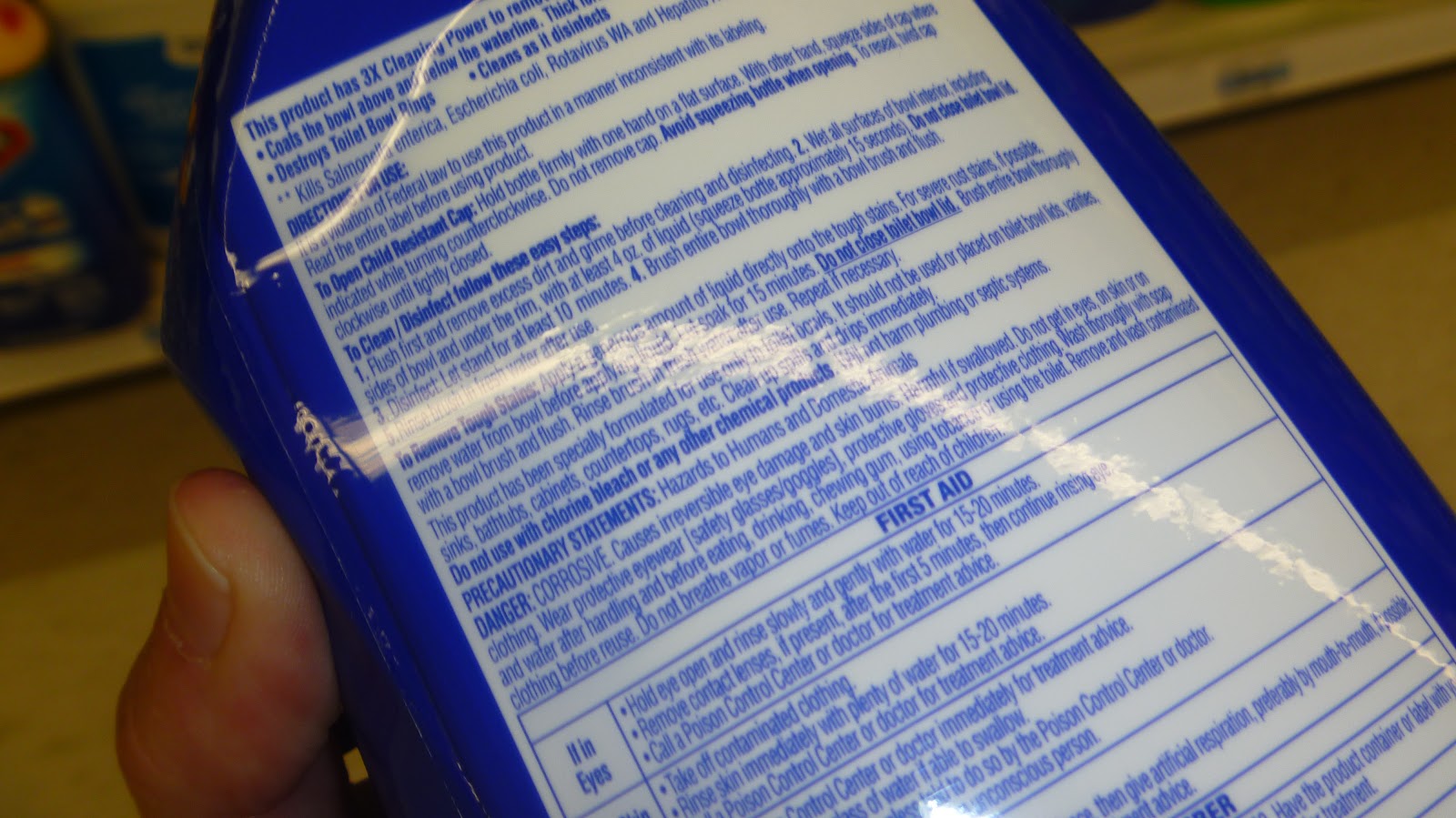
If you read the back of a toilet bowl cleaner--really read that tiny print that covers the manufacturer's butt, you might think again about using those products in your tiny, poorly-ventilated bathroom:


     DANGER: CORROSIVE.  Causes irreversible eye damage and skin burns.  Harmful if swallowed. Do not get in eyes, on skin or on clothing.  Wear protective eyewear (safety glasses/goggles), protective gloves and protective clothing.  Wash thoroughly with soap and water after handling and before eating, drinking, chewing gum, using tobacco, or using the toilet. Remove and wash contaminated clothing before reuse.  Do not breathe vapor or fumes.  Keep out of reach of children.


It may sound like you're suiting up for a Superfund site, but it's just cleaning your toilet.  Do you really think this is necessary?  Is the threat of these chemical toilet bowl cleaners worth the hour or so of a bacteria-free toilet?  Could you consider using vinegar instead of a toxic brew to keep your family safe and keep your toilet just as clean?


Safer Alternatives

If you are a busy person who does not want to bother making your own cleaners, buy a nontoxic brand like Seventh Generation or Mrs. Myers.  They're a bit pricier than the chemical variety, but way safer.

There are many recipes for low cost, safe toilet bowl cleaners.  If you do a search on-line, you'll come up with oodles.  I simply pour some white vinegar into the toilet bowl (maybe a couple cups--I don't know), scrub the bowl with the toilet brush and let it set until the next use.  Close your toilet brush handle under the toilet seat so the brush drips into the toilet bowl before storing the brush.  You can also add some vinegar to the tank of your toilet for a clean rinse next time you flush.  For an extra flourish, add baking soda to the vinegar--oh that is so much fun!

Friday, May 4, 2012

My Windows are calling....

It's a rainy, gray day here in Vermont, and yet I can see very clearly that my windows are in need of spring cleaning.  The idea of using smelly ammonia-based window cleaners in my tiny apartment is not appealing.

Fortunately, there is an easy alternative that is much cheaper and much more environmentally friendly.  I was taught by my mother who was probably taught by her mother...to use white vinegar and water to clean windows.  You can put a mixture of half water and half white vinegar in a spray bottle or a bucket.

Unfortunately, if you have been using commercial cleaning products on your windows, it has probably left a waxy film on the glass.  You must use a bit of soapy water to clean this off before you can use the simple vinegar recipes.

The smell of vinegar is potent, but it dissipates after a few hours.  As does ammonia I suppose, but vinegar doesn't scare me...ammonia does.  I don't want it on my skin, I don't want to breathe it.

To dry the windows, I use crumpled up newspaper to make them streak free.  This also works great on mirrors too!

So, what's in the commercial window cleaners other than ammonia?  Since the federal government does not require cleaning companies to put all the ingredients on the label, it's hard to say.  Windex-like products typically contain detergents (petroleum-based), the ammonia, a chemical-based fragrance to moderate the odor of ammonia, and some form of dye to make the product blue or green.

That's a lot of chemicals just to clean a window!

Remember the movie, My Big Fat Greek Wedding?  The dad thought Windex could be used for anything, even body ailments.  I actually believe vinegar is the great "fix-it."