Thursday, August 30, 2012

Nontoxic Fingernails

Today, I had a message at work from a woman asking if she should put her fingernail polish in with her husband's hazardous waste pile to take to a hazardous waste collection.  I called her back and told her that most nail polish is hazardous and that yes, she should add it to the pile.

I had nail polish on my list of articles to write for this blog, and the call this morning has spurred me on to write about nail polish and nail polish removers.

Nail Polish

I don't paint my nails very often, but when I do, I try to use a non-toxic polish.  I say "try" because in April 2012, the California Environmental Protection Agency published results of testing they did on reportedly "nontoxic" nail polishes to find that many of them are indeed toxic.  The story was picked up by ABC, CBS, and NBC networks.

The California Agency bought 25 products and sent samples to an independent lab to text for the "toxic trio" often found in nail polishes: dibutyl phthalate, toluene, and formaldehyde.  Dibutyl phthalate is absorbed through the skin and can cause developmental defects of fetuses, especially males.  Toluene can cause occupational asthma.  Formaldhyde is a probable carcinogen.  No wonder nail polish is so stinky.  Imagine painting people's nails for a living.  Not a healthy profession, and those paper masks aren't going to help.

What the Agency found from the tests is that some of the nail polish with labels that claimed the product to be "nontoxic" contained at least one of the toxic trio.  And some of the products that did not make any claims to be nontoxic, were actually nontoxic with none of the toxic trio.  So, there is no telling what is in the nail polish without accurate labeling requirements. So, once again, we are buying unregulated products that can be harmful. 

Nail Polish Remover

And then you have to take the polish off at some point.  I once had a pedicure and the nail polish lasted for over a month until I got sick of it and removed it.  My nails didn't look very good after being deprived of oxygen for so long, and the remover really stunk.  I actually used polish remover once to clean a part on a car--I can't remember the details now, but found that it worked quite well.

Most nail polish removers are highly toxic containing acetone.  Acetone poisoning
symptoms are described in a National Institutes of Health document including lowering blood pressure, nausea, vomiting, sweet taste in the mouth, acting as if drunk, difficulty breathing, among many other symptoms.

A common alternative, which is also hazardous due to its flammability, is ethyl acetate.  The US EPA considers it to be relatively nontoxic even though it can cause vomiting, headaches in large amounts.  I suppose vodka could have the same effect.  Hmmm...is vodka a hazardous product?  That could be another post another time.  Choose your poison...preferably vodka to nail polish remover, I think!

Nontoxic Alternatives

Check out various nail polish and removers products at the Skin Deep cosmetics database.   I do know of some supposedly nontoxic nail polish brands that are not on this database.  In my bathroom, I have Peacekeeper and Sante polishes and Suncoat nail polish remover.  The Sante and Suncoat nail products on not in the database.  The Peacekeeper nail polish (2006 formula) does not sound good.  I bought this one more recently so, again, I don't know what's in it.

On the Peacekeeper web site it says, "Rated by the Environmental Working Group as the Safest Paint-Based Natural Nail Polish! Natural Nail Polish at its best! The Environmental Working Group's Cosmetics Safety Database (www.cosmeticsdatabase.org) has independently rated our Eco-Smooth Nail Paints on a scale of 0.0 (for nontoxics like water) and 10 (for products with the highest toxicity). Our polishes, at rank 3, are the highest rated paint-based nail polish.  AND they're 100% Vegan! Who could ask for anything more?"

Well, I could ask that they update their website because I don't find that information on the Skin Deep cosmetics database.  And there are nail polishes in the database that rank at "1" or "2" in toxicity which is lower than Peacekeeper.  And the Peacekeeper I do find is rated as a "4."

You could just eliminate nail polish and removers from your life--and go green.  Your nails will be healthier and your indoor air quality will improve.  Naked nails can be sexy.  Check out this article on buffing.

Monday, August 13, 2012

Teen Angst & the Pharmacy

Prescription drug availability is a real problem.  We keep our drugs on the counter, in the kitchen cupboard, on the dresser, on the night stand, in the medicine chest....  This may be quite a temptation to someone in your household, especially teens.  (Those people that are between childhood and adulthood are going through incredible physical, mental, and emotional change and turmoil.) Would you notice if a few of your pills were missing?  Maybe there are old prescriptions you've saved that you're not using anymore.  Do you know how many pills are in the bottle?  Is there a prescription that you only use when you're in pain and not on a regular basis?  Do you know how many pills are in that bottle?

I think I told you how old I am in the first post, but in case you've forgotten, I'm 54--still.  And since I am a dinosaur, I feel comfortable (well, almost) telling you about my teen years which were a very long time ago, but memorably less than stellar.

I used to be incredibly depressed as a teen.  There are things about my teen years that I don't fully understand even now, but somehow cutting myself with a razor on my wrists put me in control of all the pain.  I was in my mid-teens, maybe around 14 or 15.  School was difficult, relationships at school were difficult, there was peer pressure to have a boyfriend and have sex, and there were abundant drugs available.  Smoking pot during the school lunch hour was very common, and it was out in the open.  Pregnancy looked like a contagious disease, and the adults were not responsive to a request for sex education.  I can still think of at least 10 girls who were pregnant during my tenure at high school in northern New Hampshire.  It was a relatively small school.  I think there were about 60 kids in my graduating class, so the percentage of pregnant girls seems very high to me--and those were the ones I knew about. 

All the cool kids would go to the high school dances across the river in Vermont.  And by "cool," I guess I mean the ones whose parents were clueless or had raised their kids to be more responsible than I was.  My parents were clueless.  I was not a bad kid, I was unhappy, and I wanted to feel better.  I don't remember kids using prescription meds then.  We were more into the over-the-counter meds like No-Doze for an upper and liquid cough medicine for the alcohol.   How stupid, you say?  Well, yes, this is the point.  But we didn't care!  Pop some over-the-counter pills?  Sure, why not.  Life is so boring/confusing/traumatic, why the hell not? At the Vermont dances, there was a lot of activity in the restrooms and the parking lots getting high. 

My parents let me go to the dances because my best friends' father would take us and pick us up.  What my parents didn't know and I never told them is that Mr. X was usually a bit wasted himself with alcohol.  It seemed like everyone was trashed, so why would it feel like a problem?

I'm telling you some of the gory details of my youth to make a point.  And I hope that you, reader, will consider your past and the confusion you may have experienced in growing up.  The teenage years are tough!  They can be really tough.  I'm not a parent, so I can't preach at anyone about parenting, but there seems to be a huge problem about kids and drugs.  I'm not even talking about the illegally produced street drugs, but the ones in your medicine chest. 

So conjure up your teenage angst to help you relate to the following.

Pharm Parties

My nephew being a great sport to pose.
How about some trail mix?  No, not that kind!  OK, how about some Skittles?  The recipe for either is to steal prescription drugs from someone's medicine cabinet (easiest to get your parents' drugs -- they won't notice), then go to a pharm party where all the other kids have done the same thing, take the drugs out of their labeled containers and dump them into a bowl and mix.  Now, grab a handful and wash them down with an alcoholic beverage.  Adderall, Xanax, OxyContin, Vicodin, morphine, whatever....  Trashed, baby, trashed.  Just not the painful normal. 

Oh my gosh, now imagine you're the ER doctor who gets one of these kids who is unconscious and foaming at the mouth.  If you knew what the kid had taken for a drug, maybe you'd know what to do.  But you have no idea--it was a "pharm party" with any prescription drugs they could get hold of.  What do you do?  Damn!  Or maybe you're lucky, and it was a kid who was more savvy about which drugs gave her the high she was looking for and you can find out what she had access to at home or school.  Have a look at this clip from The Drs.

While there has been a marked decrease in the use of some illegal drugs like cocaine, data from the National Survey on Drug Use and Health show that nearly one-third of people aged 12 and over who used drugs for the first time in 2009 began by using a prescription drug non-medically.  Check out this ABC News Report video from 2010 on pharming and prescription drug addiction in teens.

And This is My Problem How?

If you live alone and no one has access to your home and therefore your prescriptions, maybe you're just fine.  But if you live with others, in particular those people who are going through hormonal changes, are moody, think you're stupid, and are just generally not having fun, not really, then you should be locking up your medicines and keeping track of how many pills you have.  Yeah, you locked them up, but teenagers are tenacious about getting what they want.  Do you remember?  I remember.  Make sure you do a really thorough job of locking them up.  You don't leave a loaded gun lying around.  Don't leave your drugs lying around either. 

And yeah, you should talk to them about this.  I wish someone had talked to me, but I think I scared my parents so badly that they just watched my downward spiral from afar wishing they knew what to do and just hoping it would pass.  

Dispose of Unwanted, Unused, or Expired Medicines

If you have prescriptions that you no longer need or that have expired, dispose of them properly so they're not a temptation.  First, find out if there is an unwanted medicines take back program in your area.  There have been a few national take-back events in the last couple years.  Have a look at the Federal Office of Diversion Control web site to see if your town is participating.  The next collection is on September 29, 2012 from 10 am to 2 pm.  Who knows how many more collections will be provided if any.  The feds are trying to figure out a more efficient method of collecting unwanted medicines so we'll see.  Also contact your local pharmacy, your town office, your police department, your regional planning commission, or your solid waste management district to see if they have information about a collection.  Check out Dispose My Meds on-line to see if there is a pharmacy near you that has a meds take back program.

Do not throw meds down the drain or down the toilet.  Those drugs end up in our drinking water!

If there is no collection, mix liquid meds with something dry and throw it in the trash.  It's recommended that meds be combined with something disgusting like used kitty litter so no one will want to pull it out of the trash.  I don't have the mind-set of a drug addict, but I've read this so many times, I have to assume there is valid purpose to doing this.


"What is happening to our young people? They disrespect their elders, they disobey their parents. They ignore the law. They riot in the streets inflamed with wild notions. Their morals are decaying. What is to become of them?"
Plato, 4th Century BC

Hmm...Guess it is biological.  Have pity.

Friday, August 10, 2012

Is Your Home Safe for Children?

You want to provide a clean home for your children.  You use cleaning products that promise all kinds of benefits like killing 99.9% of all germs while making your home smell like a tropical jungle.  All surfaces will sparkle, your kids' clothes will be ultra-clean, spot-free, and fragrant.  It sounds great, but is it really? 

Most common household cleaners are harsh.  They can cause all kinds of problems: laundry detergents can cause skin irritation; cleaning product fumes can cause indoor air pollution which can cause airway problems and irritate eyes; the chemicals that make the lovely fragrances have possible links to disrupted hormone levels; and some cleaning products can kill you or your child if used improperly.

Chemical companies are not required to include all ingredients on their cleaning product or air "freshening" labels, and most products have not been thoroughly tested for human health impacts.  However, there are words to look for:  "Caution," "Warning," "Danger," "Poison," and "Keep away from children and pets."

In addition to the indirect dangers of cleaners, many children have been poisoned by sampling these products.  In 2010, U.S. poison centers answered nearly 2.4 million calls about human exposures to poisons.  In children, about 40% of poisonings involve medicines; the other 60% involve products such as plants, cleaning supplies, cosmetics, pesticides, paints, and solvents.  Poisoning is the fourth leading cause of death among children with peak incidences in children between the ages of one and three.  About half of all poison exposures occur to children under the age of six.

According to the Center for Disease Control, every day, over 300 children in the United States ages 0 to 19 are treated in an emergency department, and two children die, as a result of being poisoned. It’s not just chemicals in your home marked with clear warning labels that can be dangerous to children.   It includes the everyday toxic products we purchase and don't think of as hazardous such as cleaning supplies

What Can You Do?

Make sure your cleaning products and other poisons are not accessible to your child.  REMEMBER, many poisonings occur when a product is in use and the parent is occupied with cleaning or when the parent is cooking a meal.

Switch your cleaning products to low or nontoxic cleaners.  There are many cleaners on the market that are much safer--however, beware of "greenwashing" of products.  Some companies use words like "natural" and "nontoxic," but do not prove it on their labels.  Make sure the product states that all ingredients are listed, and you understand what those ingredients are.

These products are pricier, but they may be worth it to a busy parent.  You may want to consider making your own, simple cleaning products with white vinegar, baking soda, and liquid soap (see the Recipes page on this blog).  They take just minutes to make.

When You Have Hazardous Products In Your Home

The Center for Disease Control suggests:

Lock them up. Keep medicines and toxic products, such cleaning solutions, in their original packaging where children can’t see or get them.
Know the number. Put the nationwide poison control center phone number, 1-800-222-1222, on or near every telephone in your home and program it into your cell phone. Call the poison control center if you think a child has been poisoned but they are awake and alert; they can be reached 24 hours a day, seven days a week. Call 911 if you have a poison emergency and your child has collapsed or is not breathing.
Read the label. Follow label directions and read all warnings when giving medicines to children.
Don’t keep it if you don’t need it. Safely dispose of unused, unneeded, or expired prescription drugs and over the counter drugs, vitamins, and supplements. To dispose of medicines, mix them with coffee grounds or kitty litter and throw them away. You can also turn them in at a local take-back program or during National Drug Take-Back events.

Note, these national programs will probably disappear when the federal government finds a better solution--which I hope will be soon.  Never pour medicines down the drain or flush them down the toilet.  They end up in our drinking water as treatment facilities and septic systems do not remove them.

There may also be a household hazardous waste collection in your area for the toxic products you have in your home if you're not going to use them.  Call your town or the solid waste management district to find out.

Wednesday, August 8, 2012

The Pristine Toilette


We clean our homes to rid it of bacteria, but there are some places where there is constant bacteria, and no amount of cleaning will change that for any significant length of time.  I'm talking about our toilets.  If you clean the toilet with a harsh chemical to rid it of all bacteria, someone in your household will then use the toilet and you're right back where you started.  Is it worth using a hazardous cleaner which threatens your health for the fleeting moments of a pristine toilet.

The most intimate we get with our toilets is sitting on them (unless we have the flu).  It's really not necessary to kill every possible germ.  And cleaning with simple and safe ingredients such as vinegar can get rid of most if not all bacteria without jeopardizing your respiratory system.

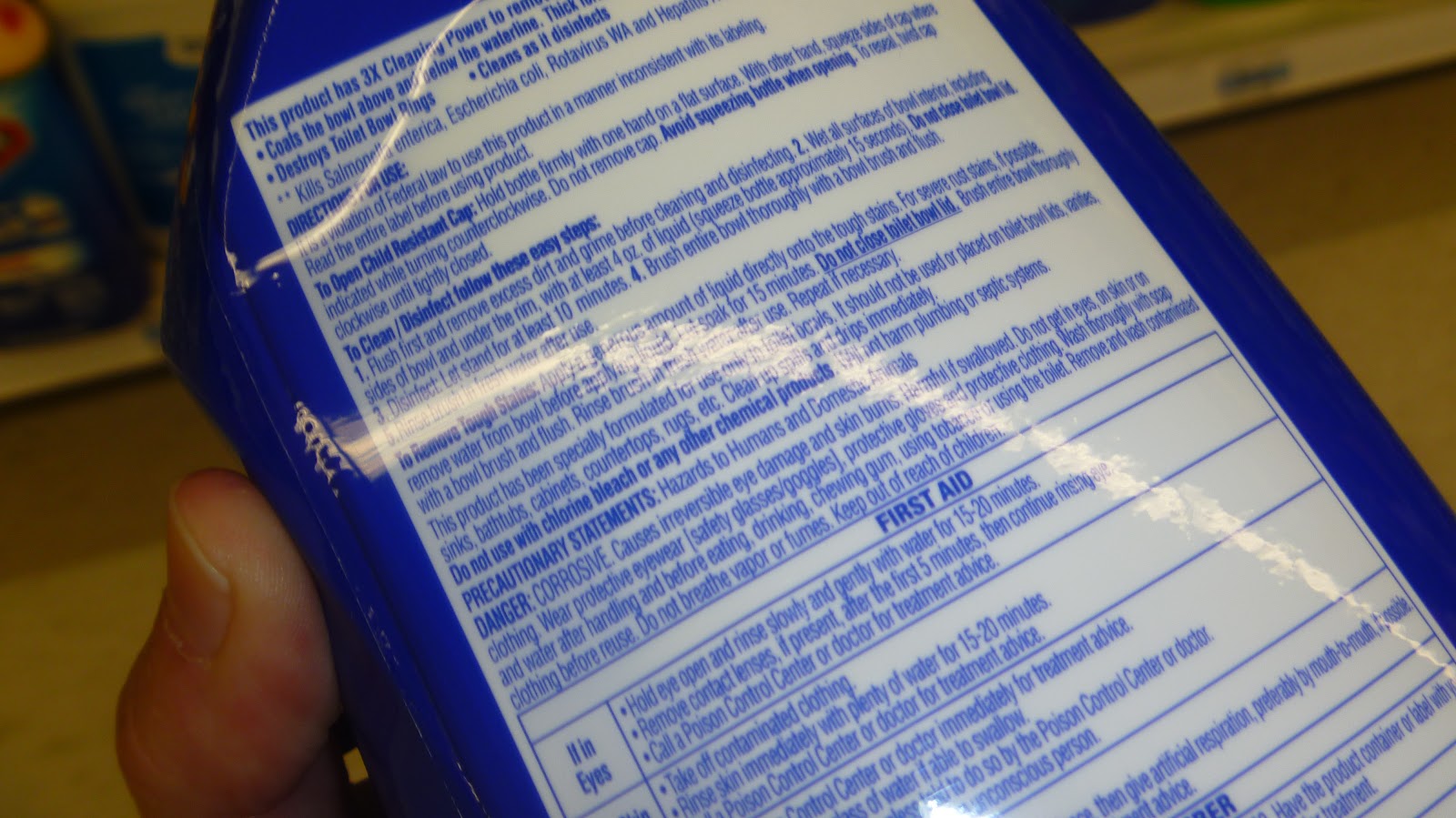
If you read the back of a toilet bowl cleaner--really read that tiny print that covers the manufacturer's butt, you might think again about using those products in your tiny, poorly-ventilated bathroom:


     DANGER: CORROSIVE.  Causes irreversible eye damage and skin burns.  Harmful if swallowed. Do not get in eyes, on skin or on clothing.  Wear protective eyewear (safety glasses/goggles), protective gloves and protective clothing.  Wash thoroughly with soap and water after handling and before eating, drinking, chewing gum, using tobacco, or using the toilet. Remove and wash contaminated clothing before reuse.  Do not breathe vapor or fumes.  Keep out of reach of children.


It may sound like you're suiting up for a Superfund site, but it's just cleaning your toilet.  Do you really think this is necessary?  Is the threat of these chemical toilet bowl cleaners worth the hour or so of a bacteria-free toilet?  Could you consider using vinegar instead of a toxic brew to keep your family safe and keep your toilet just as clean?


Safer Alternatives

If you are a busy person who does not want to bother making your own cleaners, buy a nontoxic brand like Seventh Generation or Mrs. Myers.  They're a bit pricier than the chemical variety, but way safer.

There are many recipes for low cost, safe toilet bowl cleaners.  If you do a search on-line, you'll come up with oodles.  I simply pour some white vinegar into the toilet bowl (maybe a couple cups--I don't know), scrub the bowl with the toilet brush and let it set until the next use.  Close your toilet brush handle under the toilet seat so the brush drips into the toilet bowl before storing the brush.  You can also add some vinegar to the tank of your toilet for a clean rinse next time you flush.  For an extra flourish, add baking soda to the vinegar--oh that is so much fun!

Thursday, July 26, 2012

Make Your Own Hand Soap


Have you noticed that more and more products are no longer antibacterial, but instead are advertising that their product washes away bacteria instead of killing it?  I have, and it kind of irritates me because we never needed the antibacterial chemicals added to our soaps, dishwashing liquid, or what not.  The most common additive to make a product "antibacterial" has been triclosan--a pesticide.  There are still many products out there that have triclosan or some other pesticide in them.

I know I should be grateful that fewer products contain triclosan, instead of grouching about it, but I know it's all about people getting suckered into buying something that's touted as "safer," "improved," "better for the baby," and it's not going to stop now.


There has been a lot of hoopla about these added chemicals, which I expect is causing the removal of them from products.  Some studies claim that the triclosan and similar chemicals can actually make super-bacteria: the bacteria that is not killed off by the pesticide reproduces bacteria that is resistant to pesticide.  Other studies say this is probably not true.  But either way, why should I expose myself needlessly to a pesticide?  Rub my hands in it, for Pete's sake!

There are good bacteria, neutral bacteria, and bad bacteria (pathogens) that cause illness.  But note the good bacteria.  It helps build our immune systems.  It's everywhere.  Stop trying to kill them--they're our own adorable bacteria, and they make us stronger.  Don't be a bacteria bigot!

Just washing our hands with plain soap and water gets rid of most bacteria anyway without help from pesticides. 

If you feel the need for an antibacterial soap, put a few drops of Tea Tree oil in your soap.  The Australian aboriginals have been using it for centuries to heal wounds and clear up infections.  I have not heard of Australian aboriginal men growing breasts from using tea tree oil, but there may be a connection between boys growing excess breast tissue and the use tea tree oil or lavender oil products.  Good grief!  What next?  Will we grow tails for eating too many bananas?

Here's an easy recipe for liquid hand soap:

1/3 cup liquid castile soap
2/3 cup water
5 - 10 drops of your favorite essential oil

If you like foamy soap, put the mixture in a bottle with a foam pump dispenser.  It mixes air with your soap to make the foam.  It's magic.  I bought my bottle at a food cooperative for $2.  You could also reuse one that you already have from another product.

You can buy liquid castile soap in many stores, especially health food stores and cooperatives.  The liquid soap may seem pricey, but it lasts a long time.  Dr. Bronner's soap is more concentrated than some of the others.


Saturday, July 14, 2012

The Scented Room


I like many different smells.  I love citrus and pine and lavender and any number of scents.  I think they're lovely.  But sometimes room scents are just too much, or they can smell a bit chemical-like.  When you notice that the scent is a bit overwhelming or doesn't quite have a completely natural scent, it probably is not natural.

When I was a teenager, it was the rage to have scented candles and incense in our bedrooms.  I had the little brass incense burners from India and big fat, scented candles.  When I was feeling morose (which was most of my adolescence), I would sit in my room becoming saturated with the smells of whatever I'd chosen to burn.

Today, products to create scent are a hot item for gifts and a little "me" time in the bathtub.  Women are the primary purchasers of these items and all the accessories such as holders for candles, incense sticks and potpourri.  We buy these for aromatherapy, mood-enhancements, covering up unpleasant smells, sometimes for a ceremony, a fashion accent, or event for lighting in the case of candles. The market is so good, there are specialty stores that just sell these items.

So, I used to like these smelly products--especially the berry-scented ones as I recall, but now that I'm older than dirt and I hope a little wiser, I don't like these strong smells anymore.  I pretty much don't want to smell anything unless I know it's truly natural and harmless.  When I go into a home with air fresheners, burning scented candles or incense or even potpourri, I don't find it appealing--I just wonder what I'm breathing.  I don't consider myself a paranoid person (though researching for this blog may lead me in that direction), but I am cautious about my health.

When you can smell it, you're inhaling it into your body.  Something to always keep in mind.

Air Fresheners

According to the U.S.  Environmental Protection Agency, air fresheners have four basic ingredients:  formaldehyde, petroleum distillates, p-dichlorobenzene, and aerosol propellents.  They are typically highly flammable and a strong irritant to eyes, skin, and throat.  And they report that the solid versions usually cause death if eaten by humans or pets.   I'm guessing these are young children who are drawn to the pretty colors and smells, and are more susceptible to poisonings.

Prevention magazine reports a study which has shown that more frequent users of air fresheners have an increased link to reduced heart rate variability--which is linked to heart attack and high blood pressure.

The Natural Resources Defense Council (NRDC) did a study of several air fresheners which uncovered that 12 in 14 of the tested air fresheners contain phthalates--this included the unscented varieties and the ones claiming to be "all natural."  Phthalates can cause hormonal abnormalities, birth defects, and reproductive problems.  A study by the National Institute of Environmental Health Sciences-National Institutes of Health determined that a chemical compound found in many air fresheners, toilet bowl cleaners, and other deodorizing products may be harmful to the lungs.

Those air fresheners are not sounding that good!  So how about a pretty candle?

Scented Candles

The U.S. EPA did a study on candles in 2001.  The conclusion for candles is that many candles used to have lead wicks.  Metal wicks were banned several years ago by the U.S. Consumer Product Safety Commission--but candles with metal wicks can still be found in stores.  Burning lead wicks can generate indoor airborne lead concentrations of "health concern."  Check the wick to make sure there is no metal wire in the middle of it. 

Most candles are made from paraffin unless they state otherwise.  Paraffin wax is a petroleum by-product created when crude oil is refined into gasoline. It is a white, odorless solid that is formed into slabs, and it is the most commonly used wax for candle making.  Burning paraffin candles causes indoor air pollution.  A study by the University of South Carolina showed that paraffin candles emit toxic chemicals like benzene and toluene.  The study mentioned that soy candles do not emit these nasty by-products, but bees wax was not mentioned.  (I could not find the full study on-line for a look.)  An associate professor from the New York University School of Medicine advices to use caution burning any candles in enclosed spaces. 

Scents in candles are also mostly made from petroleum.  These oils can make the candle burn inefficiently so that black soot results.  This soot has particulate matter that can be breathed in to the lungs.

If you want to set a mood, burn unscented natural candles.  My favorite candles are made from bees wax.  I love the smell even when they're not lit.  I do have some soy-based candles scented with essential oils, but some of them have put soot on my slanted wall--I'm guessing because of the oils.

Incense

A study of temple workers in Asia showed that sustained exposure to incense smoke can result in damage to DNA and greater susceptibility to cancer.

A respiratory tract cancer study in 2008 showed an association of substantial incense use with respiratory tract cancer including nasal/sinus, tongue, mouth, laryngeal and other cancers, but not lung cancer.

Most people in North American are not exposed to incense on a frequent basis, but it's something to keep in mind, especially for people who smoke.  The combination of the two could cause more irritation to the respiratory tract and increase chances of various cancers.

Bouquet of dried lavender
Potpourri

Potpourri often consists of any decoratively shaped dried plant material (not necessarily from scented plants) with strong natural and synthetic perfumes (and often colored dyes) added.  Other vegetative materials with no scent may be added for bulk and a pretty mixture.   There are spray scents to use in potpourri--these are typically synthetic.

If you want to know what is in your potpourri (and thus what you are inhaling), you can make your own.  If you dry flowers or buy dried flowers, herbs, and spices and the fragrance is not strong enough, just add a few drops of essential oils.  There are many recipes available on-line if you do a search. Many health food stores sell dried flowers such as roses or lavender in bulk as well as many herbs and spices (including orris root which is used as a scent fixative).

Safer Alternatives for Freshening the Air

soy candle from WayOutWax.com
If you can improve your ventilation for more fresh air when it's reasonable, then that's a start.  Instead of covering up a smell, get rid of it, if you can, by cleaning.  If you still want some scent in your home, consider the following:

-  Use a natural air freshener that provides all ingredients on the label for you to check and does not have aerosol propellents
-  Make an air freshener spritzer with vodka, white vinegar, or just plain water and several drops of essential oils
-  Use pure bees wax or soy candles with cotton wicks
-  If someone stinks up the bathroom (not you, of course), just light a match and hold it in the air for a few seconds
electric Aroma Stone
-  Make your own potpourri so you have control of what's in it
-  Buy an electric or clay diffuser for essential oils

Don't let anyone else tell you what smells best.  Use your head as well as your nose.


Wednesday, July 4, 2012

The Stinky Shower Curtain

When I moved into my apartment about 12 years ago, I bought a new shower curtain.  Since I only have a shower stall, I cut the curtain in half length-wise to save the second half for when the first half wore out.  (I am a frugal New Englander, afterall!)  The curtain had a strong smell in my bathroom for a long time.

After eight years, the first half was ripping off the shower curtain rings, so I discarded it, and pulled the second half out of the original plastic packaging.  The smell was intense.  After all those years, the shower curtain was still outgassing its chemicals because it had been folded up and stored in plastic holding in the toxic fumes--only to be released when I removed it from the package.

A U.S. Environmental Protection Agency study in 2002 said the toxic fumes could be smelled in a house for over a month.  In 2008, the Center for Health, Environment, and Justice performed another study which confirmed the approximate length of time the fumes remain in the home.

Key findings of the Center's report include that PVC shower curtains:

-   release over 100 chemicals into the air
-   contain high levels of phthalates
-   contain high levels of volatile organic compounds (VOCs)
-   contain organotins
-   contain lead, cadmium, and other metals
-   release an increase of chemicals with the rise of heat and humidity
-   are being phased out by retailers

Recommendations for consumers:

-   Avoid shower curtains made with PVC, as well as other PVC products, especially those that are flexible. These products are not always labeled although some may be labeled as “vinyl” or “PVC.”   This includes toys!!
-   Do not buy shower curtains that are not labeled.
-   Purchase PVC-free shower curtains made out of safer materials including organic cotton.


It can be confusing to know the difference in types of plastics since the name "vinyl" is often used for more than one kind of plastic.  The universal recycling symbol for PVC is the number "3."  (Note that very little recycling of PVC goes on.)  And when you're only given acronyms for plastic materials, it's the "C" for chlorine that should clue you in that it will be outgassing in your home.  When is "vinyl" not PVC?  The Healthy Building Network provides a quick primer on plastics.

I know more about this PVC plastic now, and I'd never buy a PVC curtain again! I figure I've got another four years to use the PVC curtain I already have.  It's already outgassed into my apartment a few years ago.  I like the idea of a fabric option as I could toss it into the wash and then hang it to dry.

And when my PVC curtain is worn out as a shower curtain, I won't throw it into the trash right away this time, I'll use it as a tarp for something else--like hauling autumn leaves into the woods.