Wednesday, August 8, 2012

The Pristine Toilette


We clean our homes to rid it of bacteria, but there are some places where there is constant bacteria, and no amount of cleaning will change that for any significant length of time.  I'm talking about our toilets.  If you clean the toilet with a harsh chemical to rid it of all bacteria, someone in your household will then use the toilet and you're right back where you started.  Is it worth using a hazardous cleaner which threatens your health for the fleeting moments of a pristine toilet.

The most intimate we get with our toilets is sitting on them (unless we have the flu).  It's really not necessary to kill every possible germ.  And cleaning with simple and safe ingredients such as vinegar can get rid of most if not all bacteria without jeopardizing your respiratory system.

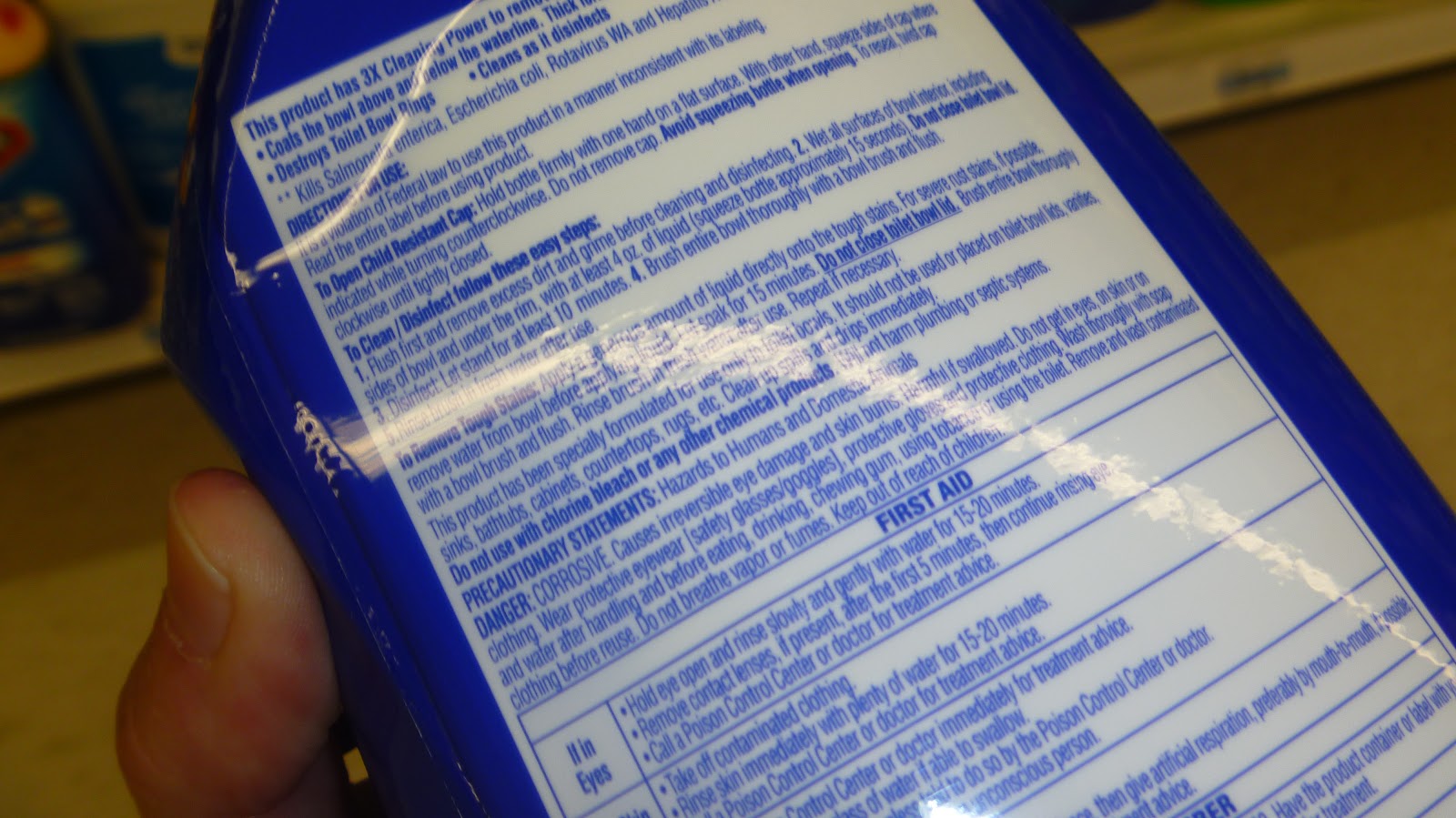
If you read the back of a toilet bowl cleaner--really read that tiny print that covers the manufacturer's butt, you might think again about using those products in your tiny, poorly-ventilated bathroom:


     DANGER: CORROSIVE.  Causes irreversible eye damage and skin burns.  Harmful if swallowed. Do not get in eyes, on skin or on clothing.  Wear protective eyewear (safety glasses/goggles), protective gloves and protective clothing.  Wash thoroughly with soap and water after handling and before eating, drinking, chewing gum, using tobacco, or using the toilet. Remove and wash contaminated clothing before reuse.  Do not breathe vapor or fumes.  Keep out of reach of children.


It may sound like you're suiting up for a Superfund site, but it's just cleaning your toilet.  Do you really think this is necessary?  Is the threat of these chemical toilet bowl cleaners worth the hour or so of a bacteria-free toilet?  Could you consider using vinegar instead of a toxic brew to keep your family safe and keep your toilet just as clean?


Safer Alternatives

If you are a busy person who does not want to bother making your own cleaners, buy a nontoxic brand like Seventh Generation or Mrs. Myers.  They're a bit pricier than the chemical variety, but way safer.

There are many recipes for low cost, safe toilet bowl cleaners.  If you do a search on-line, you'll come up with oodles.  I simply pour some white vinegar into the toilet bowl (maybe a couple cups--I don't know), scrub the bowl with the toilet brush and let it set until the next use.  Close your toilet brush handle under the toilet seat so the brush drips into the toilet bowl before storing the brush.  You can also add some vinegar to the tank of your toilet for a clean rinse next time you flush.  For an extra flourish, add baking soda to the vinegar--oh that is so much fun!

Thursday, July 26, 2012

Make Your Own Hand Soap


Have you noticed that more and more products are no longer antibacterial, but instead are advertising that their product washes away bacteria instead of killing it?  I have, and it kind of irritates me because we never needed the antibacterial chemicals added to our soaps, dishwashing liquid, or what not.  The most common additive to make a product "antibacterial" has been triclosan--a pesticide.  There are still many products out there that have triclosan or some other pesticide in them.

I know I should be grateful that fewer products contain triclosan, instead of grouching about it, but I know it's all about people getting suckered into buying something that's touted as "safer," "improved," "better for the baby," and it's not going to stop now.


There has been a lot of hoopla about these added chemicals, which I expect is causing the removal of them from products.  Some studies claim that the triclosan and similar chemicals can actually make super-bacteria: the bacteria that is not killed off by the pesticide reproduces bacteria that is resistant to pesticide.  Other studies say this is probably not true.  But either way, why should I expose myself needlessly to a pesticide?  Rub my hands in it, for Pete's sake!

There are good bacteria, neutral bacteria, and bad bacteria (pathogens) that cause illness.  But note the good bacteria.  It helps build our immune systems.  It's everywhere.  Stop trying to kill them--they're our own adorable bacteria, and they make us stronger.  Don't be a bacteria bigot!

Just washing our hands with plain soap and water gets rid of most bacteria anyway without help from pesticides. 

If you feel the need for an antibacterial soap, put a few drops of Tea Tree oil in your soap.  The Australian aboriginals have been using it for centuries to heal wounds and clear up infections.  I have not heard of Australian aboriginal men growing breasts from using tea tree oil, but there may be a connection between boys growing excess breast tissue and the use tea tree oil or lavender oil products.  Good grief!  What next?  Will we grow tails for eating too many bananas?

Here's an easy recipe for liquid hand soap:

1/3 cup liquid castile soap
2/3 cup water
5 - 10 drops of your favorite essential oil

If you like foamy soap, put the mixture in a bottle with a foam pump dispenser.  It mixes air with your soap to make the foam.  It's magic.  I bought my bottle at a food cooperative for $2.  You could also reuse one that you already have from another product.

You can buy liquid castile soap in many stores, especially health food stores and cooperatives.  The liquid soap may seem pricey, but it lasts a long time.  Dr. Bronner's soap is more concentrated than some of the others.


Saturday, July 14, 2012

The Scented Room


I like many different smells.  I love citrus and pine and lavender and any number of scents.  I think they're lovely.  But sometimes room scents are just too much, or they can smell a bit chemical-like.  When you notice that the scent is a bit overwhelming or doesn't quite have a completely natural scent, it probably is not natural.

When I was a teenager, it was the rage to have scented candles and incense in our bedrooms.  I had the little brass incense burners from India and big fat, scented candles.  When I was feeling morose (which was most of my adolescence), I would sit in my room becoming saturated with the smells of whatever I'd chosen to burn.

Today, products to create scent are a hot item for gifts and a little "me" time in the bathtub.  Women are the primary purchasers of these items and all the accessories such as holders for candles, incense sticks and potpourri.  We buy these for aromatherapy, mood-enhancements, covering up unpleasant smells, sometimes for a ceremony, a fashion accent, or event for lighting in the case of candles. The market is so good, there are specialty stores that just sell these items.

So, I used to like these smelly products--especially the berry-scented ones as I recall, but now that I'm older than dirt and I hope a little wiser, I don't like these strong smells anymore.  I pretty much don't want to smell anything unless I know it's truly natural and harmless.  When I go into a home with air fresheners, burning scented candles or incense or even potpourri, I don't find it appealing--I just wonder what I'm breathing.  I don't consider myself a paranoid person (though researching for this blog may lead me in that direction), but I am cautious about my health.

When you can smell it, you're inhaling it into your body.  Something to always keep in mind.

Air Fresheners

According to the U.S.  Environmental Protection Agency, air fresheners have four basic ingredients:  formaldehyde, petroleum distillates, p-dichlorobenzene, and aerosol propellents.  They are typically highly flammable and a strong irritant to eyes, skin, and throat.  And they report that the solid versions usually cause death if eaten by humans or pets.   I'm guessing these are young children who are drawn to the pretty colors and smells, and are more susceptible to poisonings.

Prevention magazine reports a study which has shown that more frequent users of air fresheners have an increased link to reduced heart rate variability--which is linked to heart attack and high blood pressure.

The Natural Resources Defense Council (NRDC) did a study of several air fresheners which uncovered that 12 in 14 of the tested air fresheners contain phthalates--this included the unscented varieties and the ones claiming to be "all natural."  Phthalates can cause hormonal abnormalities, birth defects, and reproductive problems.  A study by the National Institute of Environmental Health Sciences-National Institutes of Health determined that a chemical compound found in many air fresheners, toilet bowl cleaners, and other deodorizing products may be harmful to the lungs.

Those air fresheners are not sounding that good!  So how about a pretty candle?

Scented Candles

The U.S. EPA did a study on candles in 2001.  The conclusion for candles is that many candles used to have lead wicks.  Metal wicks were banned several years ago by the U.S. Consumer Product Safety Commission--but candles with metal wicks can still be found in stores.  Burning lead wicks can generate indoor airborne lead concentrations of "health concern."  Check the wick to make sure there is no metal wire in the middle of it. 

Most candles are made from paraffin unless they state otherwise.  Paraffin wax is a petroleum by-product created when crude oil is refined into gasoline. It is a white, odorless solid that is formed into slabs, and it is the most commonly used wax for candle making.  Burning paraffin candles causes indoor air pollution.  A study by the University of South Carolina showed that paraffin candles emit toxic chemicals like benzene and toluene.  The study mentioned that soy candles do not emit these nasty by-products, but bees wax was not mentioned.  (I could not find the full study on-line for a look.)  An associate professor from the New York University School of Medicine advices to use caution burning any candles in enclosed spaces. 

Scents in candles are also mostly made from petroleum.  These oils can make the candle burn inefficiently so that black soot results.  This soot has particulate matter that can be breathed in to the lungs.

If you want to set a mood, burn unscented natural candles.  My favorite candles are made from bees wax.  I love the smell even when they're not lit.  I do have some soy-based candles scented with essential oils, but some of them have put soot on my slanted wall--I'm guessing because of the oils.

Incense

A study of temple workers in Asia showed that sustained exposure to incense smoke can result in damage to DNA and greater susceptibility to cancer.

A respiratory tract cancer study in 2008 showed an association of substantial incense use with respiratory tract cancer including nasal/sinus, tongue, mouth, laryngeal and other cancers, but not lung cancer.

Most people in North American are not exposed to incense on a frequent basis, but it's something to keep in mind, especially for people who smoke.  The combination of the two could cause more irritation to the respiratory tract and increase chances of various cancers.

Bouquet of dried lavender
Potpourri

Potpourri often consists of any decoratively shaped dried plant material (not necessarily from scented plants) with strong natural and synthetic perfumes (and often colored dyes) added.  Other vegetative materials with no scent may be added for bulk and a pretty mixture.   There are spray scents to use in potpourri--these are typically synthetic.

If you want to know what is in your potpourri (and thus what you are inhaling), you can make your own.  If you dry flowers or buy dried flowers, herbs, and spices and the fragrance is not strong enough, just add a few drops of essential oils.  There are many recipes available on-line if you do a search. Many health food stores sell dried flowers such as roses or lavender in bulk as well as many herbs and spices (including orris root which is used as a scent fixative).

Safer Alternatives for Freshening the Air

soy candle from WayOutWax.com
If you can improve your ventilation for more fresh air when it's reasonable, then that's a start.  Instead of covering up a smell, get rid of it, if you can, by cleaning.  If you still want some scent in your home, consider the following:

-  Use a natural air freshener that provides all ingredients on the label for you to check and does not have aerosol propellents
-  Make an air freshener spritzer with vodka, white vinegar, or just plain water and several drops of essential oils
-  Use pure bees wax or soy candles with cotton wicks
-  If someone stinks up the bathroom (not you, of course), just light a match and hold it in the air for a few seconds
electric Aroma Stone
-  Make your own potpourri so you have control of what's in it
-  Buy an electric or clay diffuser for essential oils

Don't let anyone else tell you what smells best.  Use your head as well as your nose.


Wednesday, July 4, 2012

The Stinky Shower Curtain

When I moved into my apartment about 12 years ago, I bought a new shower curtain.  Since I only have a shower stall, I cut the curtain in half length-wise to save the second half for when the first half wore out.  (I am a frugal New Englander, afterall!)  The curtain had a strong smell in my bathroom for a long time.

After eight years, the first half was ripping off the shower curtain rings, so I discarded it, and pulled the second half out of the original plastic packaging.  The smell was intense.  After all those years, the shower curtain was still outgassing its chemicals because it had been folded up and stored in plastic holding in the toxic fumes--only to be released when I removed it from the package.

A U.S. Environmental Protection Agency study in 2002 said the toxic fumes could be smelled in a house for over a month.  In 2008, the Center for Health, Environment, and Justice performed another study which confirmed the approximate length of time the fumes remain in the home.

Key findings of the Center's report include that PVC shower curtains:

-   release over 100 chemicals into the air
-   contain high levels of phthalates
-   contain high levels of volatile organic compounds (VOCs)
-   contain organotins
-   contain lead, cadmium, and other metals
-   release an increase of chemicals with the rise of heat and humidity
-   are being phased out by retailers

Recommendations for consumers:

-   Avoid shower curtains made with PVC, as well as other PVC products, especially those that are flexible. These products are not always labeled although some may be labeled as “vinyl” or “PVC.”   This includes toys!!
-   Do not buy shower curtains that are not labeled.
-   Purchase PVC-free shower curtains made out of safer materials including organic cotton.


It can be confusing to know the difference in types of plastics since the name "vinyl" is often used for more than one kind of plastic.  The universal recycling symbol for PVC is the number "3."  (Note that very little recycling of PVC goes on.)  And when you're only given acronyms for plastic materials, it's the "C" for chlorine that should clue you in that it will be outgassing in your home.  When is "vinyl" not PVC?  The Healthy Building Network provides a quick primer on plastics.

I know more about this PVC plastic now, and I'd never buy a PVC curtain again! I figure I've got another four years to use the PVC curtain I already have.  It's already outgassed into my apartment a few years ago.  I like the idea of a fabric option as I could toss it into the wash and then hang it to dry.

And when my PVC curtain is worn out as a shower curtain, I won't throw it into the trash right away this time, I'll use it as a tarp for something else--like hauling autumn leaves into the woods.


Monday, June 25, 2012

Bountiful Button Batteries

Aren't those flashing sneakers that kids wear adorable?  Every step they take, the sneaker lights up at the heel.  And those little stuffed animals, toys, and children's books that make realistic sounds like various birds--hawks, blue jays, robins....  And the greeting cards we can purchase now.  You open one up and it sings to you.  How cool is that!

Fast forward--the sneakers are no longer blinking, the birds are no longer squawking, and the song from the card is waning--if you keep your cards that long.  Now what happens to those products that no longer function properly.  The batteries inside have died, so of course you'll just throw out the product, won't you?


The tiny, worn out button batteries inside these products are hazardous waste.  Does this surprise you?   It seems like there should be instructions about what to do with the batteries when they're spent--but there are not instructions or warnings with most of these products.

Most button cell batteries  contain mercury, silver, cadmium, lithium or other heavy metals as their main component.  Button cell batteries can contain up to 25 ppm (parts per million) of mercury. Mercuric-oxide batteries may contain up to 50% mercury by weight. Mercury can cause nerve damage and can bioaccumulate in fish and other aquatic species.   Cadmium can damage the lungs and kidneys.

Remember the saying, "Mad as a Hatter"?  This is a historic expression going back to the 19th century when mercuric nitrate was used to shape and convert fur into felt hats.   In those days, hatters commonly exhibited slurred speech, tremors, irritability, shyness, depression, and other neurological symptoms from mercury exposure.  And thus was born the expression, “mad as a hatter.”  Lewis Carroll used a "mad hatter" character in his story, "Alice in Wonderland."

When we throw button batteries into the trash, we are adding to the air pollution from the waste incinerators and contributing to the hazardous concoctions leaving landfills as leachate.  The leachate is treated similarly to sewage wastewater and then eventually put back into our water systems.

Button batteries are incredibly common these days, they're not just in children's products.  We have them in our cameras, penlights, hearing aids, watches, calculators, electronic tea candles, flashing jewelry, remote control devices, fever thermometers, and lots more.

What To Do If Someone Swallows a Button Battery?

There are other dangers of button batteries.  In the United States, more than 3,500 people of all ages swallow miniature disc or “button” batteries--every year.  A CBS News Report tells us that the battery may lodge in the throat or esophagus where body fluids can erode the battery within two hours releasing its toxic metals which can damage the body's tissue.  

Information about the symptoms after swallowing a button battery are similar to the flu according to the MedLine Plus fact sheet from the National Institutes of Health.  If someone swallows a battery, immediately call the local 911, the National Button Battery Ingestion Hotline at 202-625-3333 or the National Poison Control Center at 1-800-222-1222.

What Do I Do with Spent Batteries?

Keep in mind that when batteries no longer operate a product, it does not mean the battery is completely dead.  So, there is a possibility that they could start a fire if stored together.  You might consider putting tape on the batteries so they do not short each other to potentially explode or cause a fire.  They can also explode when exposed to extreme heat as shown on a YouTube video (everything's on YouTube).  This is an extreme example, but I also found that batteries can explode when in metal containers such as trash cans left in direct sunlight.

Many recycling sources recommend taping the terminals on batteries prior to storing in preparation for recycling or disposal.  In the case of button batteries, you should tape the entire battery.  If you have several button batteries, you can also lay out a strip of tape with the sticky side up and place a number of button batteries on the tape so the batteries do not touch each other, and then cover them with another piece of tape--sticky side down to sandwich the batteries between the tape strips.  Place taped, spent, button batteries in a child-proof container such as a prescription bottle and store out of reach of children. 

Sometimes, retailers such as pharmacies will accept spent button batteries back.  If not, contact your municipal government or solid waste management district to find a household hazardous waste collection for your batteries.

Maybe we could live without so many button batteries, by choosing products without hazardous parts.  Want to give a singing greeting card?  Hand-deliver it and sing a tune yourself!


Saturday, June 16, 2012

The Family Camp & Greenwashing

Grammy & Grampa taking a break while building our camp
Today, my family met out at our lakeside camp in New Hampshire.  My grandparents built the camp in the 1950s.  Some of the lumber used to build the camp was made at my father's sawmill.  When my grandparents died, my parents bought the camp and later deeded it to my siblings and me.  It's a spectacular place right on the lake with a mountain and lots of conserved land on the other side of the lake.  This year there are two baby loons, and we heard the loons calling on and off all day.

The lake is precious to us, and we want to protect it and keep it clean.  But somehow toxic products pop up at our camp every year--potential threats to the cleanliness of the water--not to mention our own bodies.  Septic systems (and sewage treatment plants) are not designed to remove all toxins.  So these chemicals can end up in our water supplies.  Lakefront properties are more likely to pollute as there is a shorter distance from leach fields to water.  And old camps are notorious for having archaic septic systems such as holding tanks that can overflow, or even an old car body for the septic tank--really!

We were gathered on this gorgeous day at the camp to clean it and do repair work before my cousins arrive for a visit.  My mother was cleaning with a commercial cleaner that stunk up the camp.  She taught me to clean with vinegar and yet there she is with a toxic, pine-perfumed cleaner she'd found under the sink going at all the kitchen cabinets.  I acted indignant which did not help (I regress about 30 years in her presence), and I stayed outside weeding until she was finished.  There was also white vinegar which I mixed with water and used to clean walls, floors, and windows.

Poster Product for "Greenwashing"
When I looked under the sink, all kinds of toxic products had grown there since last year.  This included fabric deodorizers, furniture polish, chlorine, and ammonia.  All unnecessary in my opinion since there are nontoxic alternatives (see recipes page).   Another product under the sink was "Simple Green All-Purpose Cleaner."  I think of this product as the poster product for "greenwashing."  Doesn't this name sound wonderful?  "Simple" implies that there are very few ingredients so it should be good for the environment.  And the word "green," well, nuf said.  They do not list their ingredients on the label, but it does say, "Non-Toxic" and it has the Good Housekeeping seal which provides a warranty for effectiveness, not safety.

I looked up the MSDS (materials safety data sheet) for Simple Green and found it is mostly water with other ingredients of 2-butoxyethanol, ethoxylated alcohol, tetrapotassium pyrophosphate, sodium citrate, fragrance, colorant.  There's nothing simple or green about this product which is labeled as "non-toxic." 

I'll just stick to the first ingredient after water--which is plentiful fodder for this discussion as you'll see.  The ingredient 2-butoxyethanol has several other names including butyl cellosolve.  Many products use this chemical including glass cleaners.  The U.S. Department of Labor, Occupational Safety & Health Administration states that 2-butoxyethanol exposure can produce a variety of symptoms, health effects, and can affect eyes, skin, respiratory system, the central nervous systems, hematopoietic system (production of blood), blood, kidneys, liver, and lymphoid system.  I know there may be a relatively small amount of this chemical in Simple Green, but I don't know at what point it will affect me.  And if I am exposed to a bunch of other cleaners with similar or reactive ingredients, my chances of becoming ill from exposure increase.

"Greenwashing" is defined as a company spending lots of money on advertising and trying to convince us that a product is green, while they spend very few resources on trying to actually be green.

A 2010 Greenwashing Report by TerraChoice states that more than 95% of consumer products claiming to be green were found to commit "greenwashing."  Products that are tested and certified by a reliable third-party such as EcoLogo and Green Seal, make it easier to know which products are safe for you.  Careful, however, as it is possible to actually buy a "green-sounding seal" on-line for as little as 15 bucks.  How about "Green as a Frog" seal, "Pure as the Driven Snow," seal or "Sunshine in a Bottle" seal?  We could make up all kinds of catchy names for a seal that sound environmentally friendly, but don't mean a thing!  When a reputable seal is not available on a product, note if they provide a list of all ingredients--they'll tell you if it's a complete list if they have nothing to hide.  You can also check out the National Institutes of Health Household Products Database.  And of course, you can search for the MSDS on line to see for yourself what ingredients are in the product.  Can't pronounce an ingredient?  Don't buy the product unless it explains what it is and it sounds safe.

Check out the recipes page on this site to find recipes for nontoxic cleaners made with simple, green ingredients that work and won't kill you.   Vinegar, baking soda, and glycerine soap just aren't that scary! 

Next time I go out to camp, I won't be cleaning, I'll be swimming, canoeing, or just sitting on the deck enjoying the sounds and view.


Monday, June 11, 2012

Mothball Madness

-->
I just went out by my landlord’s shed looking for my cat.  The stench from mothballs was incredible.  And there lay my kitty next to the shed inhaling those noxious fumes. 

So, I asked my landlord why he has mothballs in his shed.  He said there were so many mice in there, he had to do something.  Mothballs for mice?  Are they also "miceballs"?  I don’t think so, and even if they were, they’re still nasty, noxious poisons that I don’t want to smell.  I don’t want my cat to inhale them, I don’t want my landlord’s dog to inhale them, I don’t want the foxes that have been outside doing their weird scream inhaling them.

The National Pesticide Information Center says that mothballs, flakes, crystals, or bars are all insecticides.  (This website very clearly states that mothballs are not snake repellent—so somewhere out there, people are thinking that mothballs are actually "snakeballs.")  They are solid, but slowly release a toxic gas to kill moths and other insects.  Mothballs in the U.S. are either primarily naphthalene or paradichlorobenzene.  They’re meant to be in enclosed containers to trap the insecticidal vapors and kill any moths or moth eggs or larvae on fabric.  If mothballs are in the open (like a drafty shed), they can harm people, pets, and wildlife if they touch them, breathe the vapors, or eat them.   It is illegal to use mothballs in any way other than those for the intended use of fabric protection.  (Would someone please come arrest my landlord!  Maybe he’ll lower the rent.  Okay, I just called and talked to him, and he was very reasonable about cleaning up the shed.  I will take the mothballs to a hazardous waste collection.)

Naphthalene exposure can cause headache, nausea, dizziness, and breathing difficulties.  Eating just one mothball containing naphthalene can damage a young child’s red blood cells.  Just the length of the word “Paradichlorobenzene” should scare you!  In humans, this chemical is distributed in the blood, fat, and breast milk.  While the World Health Organization considers paradichlorobenzene to be a possible carcinogen, the Environmental Protection Agency says it is “not likely to be carcinogenic to humans.”   The National Institute of Environmental Health Sciences has found relationships between mothball use to several other chronic diseases such as Non-Hodgkin Lymphoma.  I don't care what the EPA says, insecticide is poison, and it can't be a healthy thing to breathe.

OK, this is important: if you can smell mothballs, you are inhaling the insecticide.  This can cause long-term health affects.  Place these deadly orbs in an airproof container like a can with a lid and take them to a hazardous waste collection for proper disposal.

Alternatives to Mothballs

Cedar smells lovely, but it does not keep the moths away.  Cedar chests only keep moths away from your cloths because you close the chest lid to keep the moths out.  

If you're concerned about moths, place your natural fiber clothing in airtight containers or bags.  Moths don’t go for synthetics.  (I don’t either, by the way.)  But they do go for natural/synthetic blends and stains from animal sources—like blood, gravy, sweat, so don't store dirty clothes.  For existing infestations, vacuum out drawers, closets, and upholstered furniture with a HEPA (high-efficiency particulate arresting) air filter vacuum cleaner.  Lint and pet or human hair that has been undisturbed can be breeding areas for moths—a really good reason to keep a clean home.

And remember, these are mothballs--they're not "miceballs," "snakeballs," "deerballs," "slugballs"...they're mothballs.  Repeat after me...........And stop snickering about all those balls--what are you, 12?