Sunday, November 17, 2013

Sharing Your Home with Mice?

I know mice and other rodents can be a real pain.  They can be kind of cute until you find their droppings in your cutlery drawer--now that's disgusting.

So, let's think about the options for getting rid of rodents.  Maybe you'd like to send them to rodent heaven, but there might be a better and safer alternative.

Why Not Poison Rodents?

Well, you could poison them and they might die literally in your woodwork so you get to smell their rotting carcasses for quite some time.  Not really pleasant for either you or the rodent.

If you poison the rodent, and a wild animal eats the poisoned rodent, you could have poisoned the predatory bird or mammal--maybe even your pet, or your neighbor's pet.  And potentially, a child could access the poison although the U.S. Environmental Protection Agency is working on this.

If you use a poison containing bromethalin, it has no antidote for pets who ingest toxic amounts.  It affects the nervous system and any pet that has significant symptoms has a very low probability of recovery.  I didn't make this up, I heard it from two veterinarians.  My vet said that pets that eat other rodent bait intended to affect the clotting ability of animals might be saved with Vitamin K.

She further requested that people not keep bromethalin baits in their homes, barns or property.  Read for the active ingredient if you're set on poison.

The U.S. Environmental Protection Agency has banned several poisons, but unfortunately, this left a loophole for the bromethalin mentioned above.


Alternatives to Rodent Poison

See Beyond Pesticide's Minimizing Mouse Madness and check out information from the Daily Green below.
  • Seal cracks and holes in the house that can allow mice to enter. (You'll also save energy.)
  • Remove food sources that may attract them, such as trash, pet food or fallen fruit from trees. And store your food properly.
  • Housecats are nature's mouse predator. Never use mouse poison because your cat could easily ingest it along with the mouse.
  • Capture mice with live traps such as Havahart and move them far from the home.
  • Use snap traps with sensitive triggers that are more likely to kill quickly. Use as many as 10 traps near any known mouse hole, and position them about two feet apart along walls, with the bait-end against the wall. Use gloves or else your scent on the traps may make them ineffective.
  • Glue traps are unlikely to kill mice quickly, but can be effective. Keep them in place for at least five days so mice become accustomed to them.  But do you really want mice stuck to the glue and suffering until you find them to kill them?  or they starve to death?  Really not nice.
  • Repellent sound devices may or may not work, but are designed to annoy mice with a high-frequency sound that humans can't hear.  Hmm...wonder what pets will think of this?
  • Poison bait boxes can be used as a last resort. Look for tamper- and weather-proof boxes that use first-generation (multiple-dose) anticoagulants. Place them only in areas that are inaccessible to pets and children.  Remember these are dangerous and can cause unanticipated consequences.
If you do an internet search for "natural mouse repellent," you'll get more recipes for non-toxic alternatives to rodent poison.  A co-worker swears by peppermint oil on  cotton balls scattered about her house.

At the moment, I don't have any mice, but I do have a kitty.  Meow!

Photo Credit from Flickr

Tuesday, October 22, 2013

Wal-Mart Just Ticks Me Off

Will the $82 million fine change Wal-Mart's behavior?  Somewhat I expect, but why do they have to get caught doing something bad before they act responsibly.  This May, Wal-Mart was fined $82 million for dumping hazardous waste in the trash or down the drain.  The New York Times reported that Wal-Mart also was taking returned pesticides and having them processed for re-sale without a permit.  This company makes big bucks, and they know they can't dump hazardous waste in the trash, down the drain, or repackage pesticides for sale without a permit.  If they didn't train their underpaid, under-employed, and under-insured employees to do proper waste management, then that is Wal-Mart's fault.  I don't know if the $82 million fine matched the savings of illegally dumping hazardous waste into our water system or selling us re-packaged pesticide, but I hope so.


I know some might not think this topic is entirely relevant to this blog about your own cupboards--except it is!  We need to change our habits of buying toxic products so we're not polluting our bodies, our family members' bodies, our pets, or the environment.  And we should be supporting companies that do the same.  I don't expect box stores to stop selling Proctor & Gamble toxic products--that's too big to ask of chain stores that rely on cheap goods that we, yes we, demand from the store. 

The only way we can get them to change is to stop buying their crappy products.  Can we make a difference?  Yes.  This September, Wal-Mart agreed to begin reducing it's products with certain toxins.  According to USA Today, prodding by health and environmental advocates caused Wal-Mart to act.  It's a big deal, but it's just a start. 

We can send a message to retailers by not purchasing items with toxic ingredients.  We can start by cleaning our homes with white vinegar, baking soda, and other non-toxic products.

Really, we can make a difference.

Tuesday, October 15, 2013

Clean Non-Toxic Oven


I finally cleaned my oven after about five years--I am just not that into cleaning.  I had help.  It was a few weeks ago and I wanted to make a video about cleaning the oven without toxic commercial cleaners.  So my co-worker Rachel and I cleaned the oven after finally settling on a recipe to try.  There are others that might work as well, but this worked great--so I'm going with it.  We mixed about a cup of baking soda with enough white vinegar to make a paste to stick on the ceiling and walls of the oven.

First, Rachel scraped out the oven with a wooden spatula to get ride of the crusty stuff that had accumulated there.  A wooden or plastic tool will not scratch oven surfaces like metal might.  Then she mixed a cup of baking soda and about a quarter cup of white vinegar.  I thought there might be a lava overflow when she did this on camera, but she chose just the right size bowl.

I think mixing baking soda (a base chemical) with vinegar (an acid) only makes sense when you use the chemical reaction as part of the cleaning process.  These ingredients quickly kind of cancel each other out unless you get them onto the surface as soon as possible so the reaction is still occurring.

Rachel took a pastry brush and painted the interior of the oven.  She had to get back to work, so I cleaned the oven after a couple hours with a green scrubby and water.  It worked great.  There was all kinds of black goo that came off--cooked on grease.  I cleaned the oven racks separately in the sink.

So after about several years of not cleaning the oven--it was clean, without using the very toxic commercial cleaner.

Unfortunately, this week I had a hankering for crispy baked chicken wings.  The recipe said to dunk the wings into seasoned olive oil and place them on a rack over a pan.  They tasted fantastic.  They were so crispy and good, but I did not need all that oil that ended up all over my clean oven.  It also stunk up my apartment as the stove vent does not send air outside, it just circulates the air through a filter.  Everything smelled like baked chicken wings and I was breathing the odor in my sleep.

So I was back to square one, and I just finished cleaning the oven again.  This time I put a pillow on the floor for my poor knees while I slaved away on the oven.  While I had my head stuck in the oven, I was thinking that people without the self-cleaning ovens have to do the same thing--only they stick their heads into an enclosed space with toxic fumes.

What's Wrong with Commercial Oven Cleaners?


This label reads, “DANGER:  CORROSIVE. CONTAINS SODIUM HYDROXIDE (LYE).  WILL BURN EYES AND SKIN.  HARMFUL IF SWALLOWED.  Avoid contact with eyes, skin, mucous membranes and clothing.  DO NOT ingest.  Use only with adequate ventilation.  Avoid breathing spray mist.  Wear long rubber gloves when using.   

The U.S. EPA also recommends wearing an apron and protective goggles when using commercial oven cleaners.  They further recommend having plenty of fresh air as well as ventilation in the room.  Difficult to do if you have your head in the oven!

The ingredients are not provided on the label, but on-line they are listed as:

2-Ethanol, (2-butoxyethoxy), Petroleum gases, liquefied and sweetened; Sodium hydroxide, and 2-amino-Ethanol 

Why Not Just Use the Self-Cleaning Function on Ovens?

There are pros and cons to buying an oven with the self-cleaning function.  They are much more well insulated and the doors have better seals so they may be more energy efficient if you don't use the self-cleaning function too often.  However, they can be more expensive to repair (due to hidden elements) and typically, you are not supposed to leave the racks in the oven for cleaning as the high heat (around 900 degrees F) can damage a finish on the metal racks.  You also might still have to clean the oven after using the self-cleaning function to at least remove the ash.

Well, I'm going to be more conscious about what I bake now, and I don't anticipate cleaning the oven again for a very long time.


Friday, September 13, 2013

Leftover Paint? Who Cares? PaintCare

What do Oregon, California, Minnesota, Connecticut, Rhode Island, Vermont, and Maine have in common?  They have all agreed to participate in the "PaintCare" program.   PaintCare was developed by the American Coatings Association--a voluntary non-profit organization representing the paint industry--so they know about paint!

 PaintCare is a stewardship program--that means they take the stuff back that you can no longer use.  That's the gist of stewardship--a manufacturer makes it and then they take care of the remaining end product so consumers don't just throw it in the trash.  If you live in one of the above states you can already do this with paint or you will soon be able to. 

How it works is when you buy a can of paint, you pay a small additional fee to pay for the program.   When you're done with your paint, you can return the unused portion to a collection point (such as a hardware store, your local recycling center or transfer station, or wherever makes sense in your area).

Currently, most people have no option but to put their paint in the trash.  Where I live, there are household hazardous waste collections (I run some of them for my work) where people can bring their oil-based paints and other coatings.  We don't take latex paint as it's REALLY expensive to handle hazardous waste, and latex is not considered hazardous because it's water-based.  Don't get me wrong, you wouldn't want to drink the stuff, but if it can go in the regular trash (only after it's been dried out-see below), then that's where it will go.  It costs about $45 to $60 per household to get rid of hazardous waste at our collections, and at collections held elsewhere it costs much more.  So...we don't want to include latex paint as there's a lot of it out there.

The PaintCare program will take oil-based and latex paint.  It's a good thing because more and more paints are latex.   

There are also some local paint collection programs around the country.  Some programs are year-round and just collect paint.  People can pick up a can there or it gets sent off for re-manufacturing or to a waste-to-energy facility.  These are often very informal programs.

Where Does the Paint Go?

Some of the paint collected by PaintCare will be remanufactured into more paint for consumers like you and me to purchase and use.  Some paint will be sent off to be burned as a fuel.  The ultimate goal is to remanufacture the paint, but it takes time to set up the structure to allow this to happen.  Partners need to be found to perform the remanufacturing and marketing of the paint.  PaintCare will work on this structure to provide the optimal use of our paint.

In Vermont where I live, the Chittenden Solid Waste District (near beautiful Lake Champlain--home of Champ, our very own Loch Ness Monster) produces a remanufactured latex paint called Local Color.  I have visited this facility, and it's very cool.  They filter and reblend unwanted latex paint making unique colors in batches.  When they get a bunch of blue paint, they mix it together to make a special shade of blue.  If you're going to paint the living room, you'd better make sure you buy enough of that shade as the next batch of blue might be slightly different.  If you are picturing people in paint-spattered clothing pouring cans of paint into a large vat, you would be correct.  It's a small operation, but it is such a great idea run by some forward thinking folks.

Keeping Latex Paint for Future Use

Leftover latex paint will last for years if you cover the can opening with plastic wrap, top with the lid, and make sure the lid (use its original container) fits securely so the paint doesn’t leak.  Then, and here’s the key step:  store the paint can upside down.  The paint will create a tight seal around the lid, keeping the paint fresh until you need it again. Store the paint where it will not freeze. If stored correctly, paint stays in good condition for a long time. If it mixes smoothly, it can still be used. Use leftover paint for touch-up jobs, smaller projects, or as a primer.


Drying Out Latex Paint for Disposal

If you can't use your latex paint or donate it, and you don't have a paint collection in your area, just dry out the paint and throw it in the trash.  Here's how to do this:

Let it dry in a safe location away from children and pets. Less than a half inch of paint will dry out easily when the lid is off.  Larger volumes can be dried with absorbent material such as kitty litter, shredded paper, or sawdust.  Once it’s dry, dispose of the dried out latex paint as garbage.  If you end up with empty, dry metal cans, you should be able to recycle these with scrap metal at your local facility--or you might think of an artistic use for them.


Saturday, June 29, 2013

The Dang Drain is Clogged

I went to a neighborhood picnic tonight.  It was great, but when I got home to clean up, the sink backed up--almost up to the level with my clean dishes.  Really gross!

It was late, but who wants to deal with disgustingness in the morning?  Not me.  I knew my old standby of baking soda and vinegar followed by boiling water was not going to do the trick alone.  And there is NO WAY I'm going to use the commercial drain opener that can actually cause blindness if you get it in your eyes.

So, I remembered my landlord using a trick with a plunger in the sink.  (And I googled it to make sure I knew what I was doing.  See WikiHow.)  I have a double sink, so I checked which sink seemed to be the problem by poking a wooden skewer down each drain.  The one on the right was just fine, but the one on the left was clearly plugged up badly which called for drastic measures.

I put the drain plug into the right sink (wearing rubber gloves--really nasty water), then I used the plunger on the left sink.  The plug in the right sink still let water come up as the seal must not be very tight.  It took a couple tries, but I did get the left sink to drain properly.  I followed this with a dump of baking soda down the drain, followed by the vinegar to create a lovely volcano effect.  I left this for 5-10 minutes and followed up with a boiling water chaser.

My sink is just fine, thank you very much--without using something toxic and absolutely dangerous off the grocery store shelves.

NOTE; That is not an electrical cord in the photo, it's for my water filter which is NOT electric.  Just didn't want you to think I was playing with electricity in the water as my co-worker pointed out!


Water back-up in double sinks
Stick test to determine which sink is clogged
Using plunger in hot water in left sink
Adding baking soda


Adding vinegar after baking soda
Still foaming after several minutes


Saturday, May 25, 2013

May is Asthma Awareness Month

There are many irritants and triggers to asthma.  And since it is Asthma Awareness Month, I thought I'd point out another reason to switch to non-toxic household cleaners.  Below are a list of irritants from the U.S.  EPA.
  • Secondhand Smoke
  • Dust Mites
  • Mold
  • Cockroaches and Pests
  • Pets
  • Nitrogen Dioxide (gas cooking stoves, space heaters)
  • Outdoor Air Pollution
  • Wood Smoke
  • Chemicals such as Household Cleaners

About Chemical Irritants and Asthma from the U.S.  EPA

Chemical irritants are found in some products in your house and may trigger asthma. Your asthma or your child's asthma may be worse around products such as cleaners, paints, adhesives, pesticides, cosmetics or air fresheners. Chemical irritants are also present in schools and can be found in commonly used cleaning supplies and educational kits.

Chemical irritants may exacerbate asthma. At sufficient concentrations in the air, many products can trigger a reaction.

Actions You Can Take

If you find that your asthma or your child's asthma gets worse when you use a certain product, consider trying different products.

If you must use a product, then you should:
  • Make sure your child is not around.
  • Open windows or doors, or use an exhaust fan.
  • Always follow the instructions on the product label.
  • Use a nontoxic product from the store or make your own.  See the recipes page.

Thursday, March 14, 2013

Money Down the Drain

Buying commercial cleaners is not only adding toxins to your home, it's throwing money down the drain.

The cost of cleaning can be just pennies.  Nontoxic ingredients are cheap, cheap, cheap...and they work just as well as the smelly, toxic cleaners in the store.  Vinegar, baking soda, and liquid soap do not have frightening labels telling you how to call the poison control center. 

Think about what you're buying when you purchase a commercial cleaner:
  • Advertising and Marketing - The companies must convince the masses that the product is essential for a clean home.  New, improved, will rev up your sex life, make your neighbors jealous...
  • Chemical Engineering - Someone has to figure out how to make ammonia smell like a tropical rain forest--and make it a lovely green color!
  • Packaging, Shipping, and Shelf Space - OK, the nontoxic ingredients have the same issues, but I don't think the vinegar companies go to quite so much effort as the drain cleaners in their packaging designs.

What's the Difference in Cost of Typical Cleaning Products Versus Nontoxic Cleaners?

Using simple math (the kind I'm best at), I've calculated the comparable costs of nontoxic cleaners versus store-bought toxic cleaners.  Check it out!  (And hey, those are rounding errors--not my fault!)  Want to save some money and have a clean, nontoxic home?  Make your own cleaners....  (See the Recipes page)

Glass Cleaner - Windex Original costs $3.69 for 26 ounces or $0.14/ounce versus a nontoxic homemade cleaner costs $0.52 for 26 ounces or $0.02/ounce.  That's 86% cheaper.

All-Purpose Cleaner - Simple Green (boo, hiss! Greenwashing at its worst) costs $3.79 for 22 ounces or $0.17 an ounce versus a nontoxic homemade cleaner at $0.44 for 22 ounces or $0.02 an ounce.  That's 96% cheaper.

Abrasive Powder - Comet costs $0.75 for 14 ounces or $0.05 an ounce versus baking soda at $1.69 for 14 ounces or $0.12 an ounce.  OK, OK, this is one that's cheaper to buy the commercial brand, but you already have baking soda in the cupboard--and if you bought baking soda in bulk it would cost less than what I've calculated.  That's 25% more expensive for the box type of baking soda.

Abrasive Scrub - Soft Scrub costs $3.49 for 24 ounces or $0.15 an ounce versus a nontoxic homemade cleaner at $2.64 for 24 ounces or $0.11 an ounce.  That's 15% cheaper.

Toilet Bowl Cleaner - Lysol Toilet Bowl Cleaner costs $2.69 for 24 ounces or $0.11 an ounce versus $0.48 for 24 ounces of white vinegar or $0.02 an ounce.  That's 96% cheaper.

Drain Opener - Liquid Plumber costs $3.99 for 32 ounces or $0.12 an ounce.  A vinegar and baking soda cleanse costs $0.30 for one application to keep your drain clean or $0.04 an ounce.  That's 93% cheaper.


So, if reading the tiny print on the commercial cleaners doesn't make your palms sweat, then maybe saving some cash will get you to convert to simple, nontoxic cleaning.  That can be 100% safer!


Wednesday, March 6, 2013

Second-Hand Smoke and Pets

I have heard a lot about second-hand smoke and its impact on humans; but I hadn't heard anything about the impact on pets.

Recently, I went to visit a friend for several days (we'll call her "Lily").  We hadn't seen each other in 20 years so Lily reminded me that she smokes.  I thought, "no big deal, she doesn't smoke in the side of the house where I'll sleep."  And it wasn't that big of a deal because I was mentally prepared, but it did remind me how much I hate smoking.  The smoke travels around the house, and I would wake up with a smoke taste on the roof of my mouth.  And I always knew when Lily lit up even if I was at the opposite side of the house.

Lily isn't just a smoker.  She's a million other wonderful things.  She's kind-hearted to an extreme, and she rescues animals that otherwise might be put down or die from exposure.  She has 10 cats, two dogs, and a rabbit between two homes.  The stories about their previous lives make me want to cry, and I'm so grateful for people like Lily.  One cat had been shot in the face, and Lily made sure he had all the care he needed to recover as much as possible.  He's now a pretty robust cat--loving and playful.

There were seven cats in the house where I stayed, and I absolutely fell in love with one cat named Ginger Snap.  She's a Siamese kitty with a heart of gold.  Unfortunately Ginger Snap has allergies and trouble breathing sometimes.  It's heartbreaking when she has a sneezing jag.  Ginger Snap was an abandoned or lost kitten that scratched on a motel door when Lily was traveling.  She looked for the owner, but no one seemed to know anything about this kitty.  Ginger Snap has been with my friend for about 8 years now.  This kitty has been on several medications and is now on two--one for allergies and one for high blood pressure. 

Aside from Ginger Snap, a couple other kitties there have more minor wheezing or sneezing.  I thought, this can't be a coincidence.  The smoking is so irritating to my respiratory system, I wondered what could it be doing to small animals who are subjected to it for several hours a day.

According to several sources such as Petside, Science Daily, Petfinder, ASPCA, and the American Journal of Epidemiology, there is a definite link between a pet's health and its exposure to secondhand smoke.  There are 4,000 chemicals in secondhand smoke, and 43 are known to cause cancer.

Breathe New Hampshire cites the following impacts of secondhand smoke to pets: 
  • Cats exposed to secondhand smoke in the home have a higher rate of an oral cancer called squamous cell carcinoma, which may be due to the way cats groom themselves. When cats groom themselves they eat the poisons from secondhand smoke that have settled on their fur.
  • Cats exposed to secondhand smoke have a higher rate of feline lymphoma, a deadly form of cancer, than cats not exposed to secondhand smoke.
  • Cats can develop respiratory problems, lung inflammation, and asthma as a result of secondhand smoke.
  • Dogs that inhale secondhand smoke are three times more likely to develop lung or nasal cancer than dogs living in smoke-free homes.
  • Dogs can experience allergic reactions to secondhand smoke.  Common symptoms of this allergic reaction are the scratching, biting, and chewing of their skin. Owners often confuse this reaction with fleas or food allergies.
  • Cigarette butts can also be deadly. Two butts, if eaten by a puppy, can cause death in a relatively short period of time.
  • Birds can react badly to secondhand smoke and may develop eye problems, as well as other respiratory problems like coughing and wheezing.
  • Birds that sit on a smoker’s hand can experience contact dermatitis from the nicotine that remains on the smoker’s hand. This can cause them to pull out their feathers.

What Can You Do If You Smoke and Have Pets?


You can quit smoking.  I know this is a tall order.  I am a nonsmoker so I don't fully comprehend the difficulty of quitting smoking.  My Dad quit after a few decades of smoking.  He was hypnotized once, but I think he just really wanted to quit.  My co-worker quit by using nicotine gum, but he's been chewing this type of gum for years now--a better addiction, I guess.  And my niece quit for vanity--she noticed a wrinkle on her face she felt was caused by the cigarette smoke since we know a few women who smoke and their faces look ravaged.

Well, if you can't quit for your own health, maybe considering your innocent pets as well as the humans that live with you might help you to give quitting a good try.  If you fail, don't stop trying.  The road to change is not a straight line.

You could also only smoke out of doors so you're not contaminating the air, furniture, curtains, and carpeting in your home as well as your pet's fur and respiratory system.  Your pets will thank you for it--and it will reduce your vet bills.

Photo source for smoker

Thursday, January 10, 2013

What's BPA and What's it Doing in My Food?

Why would we want to eat something called Bisphenol A (BPA)?  I don't think we do.

BPA is an industrial chemical that has been used in plastics and epoxy since the 1960s.  There is a lot of controversy about this chemical which is commonly used in food and beverage containers (including the lining in most food cans).  Many studies show that BPA can seep into our food and beverages, and then into our bodies.

In 2008, the Natural Resources Defense Council petitioned the U.S. Food & Drug Administration (FDA) to eliminate BPA from all food packaging. When the agency failed to respond, NRDC sued in 2011 to make FDA respond. The court made the determination that the FDA must make a final decision on NRDC’s petition by March 31, 2012.  The FDA finally responded that they need to continue evaluating research.


According to the NRDC, "the FDA acknowledged in 2010 that it had “some concerns” about the chemical’s effects on the brain, behavior, and prostate glands in fetuses, infants, and young children. But the agency has only encouraged voluntary actions to reduce BPA exposure.  Since that time numerous studies have raised additional concerns about links between BPA and breast cancer, cardiovascular disease, diabetes and obesity.

"Consumer demand for BPA-free products has already led to the withdrawal of baby bottles, “sippy cups’’ and infant formula containers containing the chemical from store shelves.  Canada, the European Union, China, and at least five other countries as well as 11 U.S. states, all have prohibited the use of BPA in children’s products.

"In addition, some U.S. canned food manufacturers are voluntarily removing BPA from can linings, but BPA remains legal to use in all food packaging."

According to the Environmental Working Group (EWG), "certain plastics called polycarbonates leach low levels of BPA into food or liquids. Leaching from plastic baby bottles and food containers appears to happen at a much lower level than found in canned foods and baby formula. Nevertheless it is good to take simple precautions.

"BPA is found in polycarbonate plastic food containers often marked on the bottom with the letters "PC" recycling label #7. Not all #7 labeled products are polycarbonate but this is a reasonable guideline for a category of plastics to avoid. Polycarbonate plastics are rigid and transparent and used for sippy cups, baby bottles, food storage, and water bottles. Some polycarbonate water bottles are marketed as 'non-leaching' for minimizing plastic taste or odor, however there is still a possibility that trace amounts of BPA will migrate from these containers, particularly if used to heat liquids."

Is this not enough?  BPA is used in making store receipts.  The EWG reported in 2010 that "two-fifths of the paper receipts tested by a major laboratory commissioned by EWG were on heat-activated paper that was between 0.8 to nearly 3 percent pure BPA by weight. Wipe tests conducted with a damp laboratory paper easily picked up a portion of the receipts' BPA coating, indicating that the chemical would likely stick to the skin of anyone who handled them. The receipts came from major retailers, grocery stores, convenience stores, gas stations, fast-food restaurants, post offices and automatic teller machines (ATMs).

"Major retailers using BPA-containing receipts in at least some outlets included McDonald's, CVS, KFC, Whole Foods, Walmart, Safeway and the U.S. Postal Service. Receipts from some major chains, including Target, Starbucks and Bank of America ATMs, issued receipts that were BPA-free or contained only trace amounts

"Scientists have not determined how much of a receipt's BPA coating can transfer to the skin and from there into the body. Possibilities being explored include:
  • Oral exposure -- BPA moves from receipts onto fingers and then onto food and into the mouth.
  • Dermal exposure -- BPA from receipts is directly absorbed through the skin into the body.
"A study published July 11 by Swiss scientists found that BPA transfers readily from receipts to skin and can penetrate the skin to such a depth that it cannot be washed off (Biedermann 2010). This raises the possibility that the chemical infiltrates the skin's lower layers to enter the bloodstream directly. BPA has also been shown to penetrate skin in laboratory studies (Kaddar 2008)."

My local food co-ops use the BPA-free paper so I don't mind handling my receipts.  

What Can You Do?
  • Choose fresh food whenever possible like fresh vegetables and fruit instead of canned or dried beans instead of canned.
  • Write a letter to the companies you purchase from and tell them you don't want your food packaged in BPA, or your water bottle lined with BPA, or the food containers you use to contain BPA.
  • Start buying from the companies that use BPA-free packaging.  Visit these web sites for a list for canned food, sippy cups, reusable water bottles, and lunch containers.
  • Start storing your food in glass jars with metal lids.  Save those salsa and nut butter jars!
  • Do not heat food in plastic containers in the microwave--even if  it says "microwave safe." 
  • Use stainless steel, porcelain, or glass containers for hot foods.
  • Watch for bottled beverages with plastic caps--these can contain BPA as well.
Eden Organics uses BPA-free cans for beans


Saturday, December 29, 2012

All-Purpose Cleaner with Love

I don't even remember when I started using nontoxic cleaners.  I was using them unconsciously as I grew up as my mother used them.  She may have been using them to save money.  After all, she had five kids to raise, and a gallon of vinegar is a lot cheaper than a manufactured product.

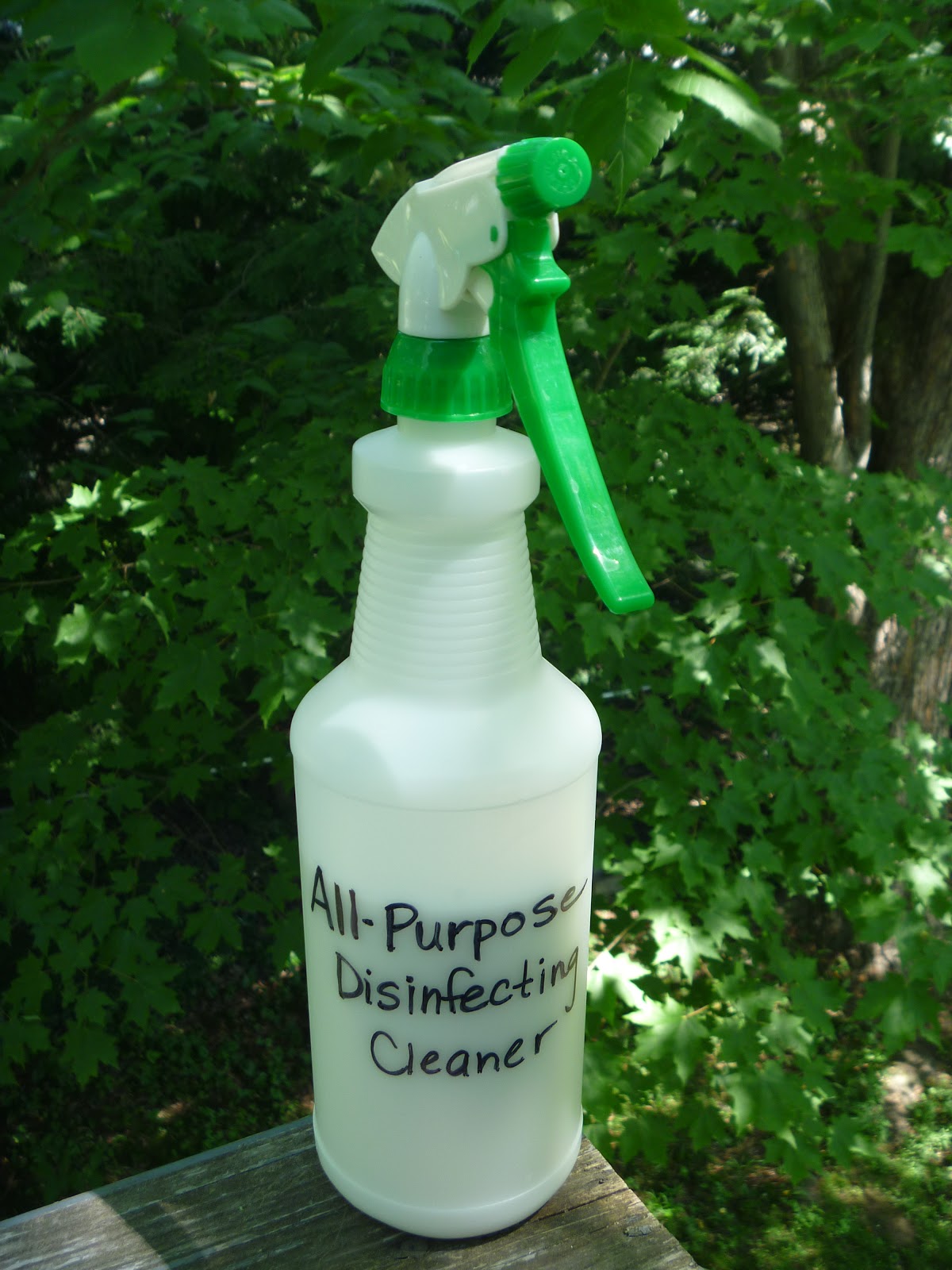
When you make your own cleaners, you should always start with a clean container.  If it's a previously used container, make sure you don't have residue from the previous contents still in the container when you put it to reuse.  Clearly mark your container so you don't confuse it with something else.  Just take a sharpie, permanent maker and write on the container.

For my all-purpose disinfecting cleaner, I use a spray bottle that can be purchased in the gardening section of many stores.  The nozzle is adjustable to regulate a misting spray to a straight shot.

I have been cleaning my apartments with a nontoxic, home-made cleaner for many years.  It's very simple and the recipe follows:

All-Purpose Disinfecting Cleaner
1 tablespoon liquid soap
1 cup warm water
2/3 cup white vinegar

In a spray bottle, mix the soap and water first to prevent clumping.  Then add the vinegar and mix gently. 

Why Use a Home-Made Cleaner?

When you make your own cleaner, you really, really know what's in it.  When you buy a cleaner, you can't be sure all of the ingredients are listed.  The U.S.  EPA gives a warning about commercial all-purpose cleaners:

       When using [commercial] all purpose cleaners, follow these safety steps:

  • Wear rubber gloves to protect your skin
  • Be sure that there is good air circulation in the room. Open several windows or keep a fan running.
  • NEVER mix two cleaners of different kinds together, especially if one contains ammonia and the other contains chlorine. This can produce a gas called chloramine, and breathing its fumes could be fatal.
You could buy a commercial cleaner containing bleach to kill germs, but white vinegar also kills germs.  So, why pay more for a cleaner that can harm you?  Just make your own.


Thursday, November 15, 2012

Just a Few (of the many) Things I Didn't Know

I live on the border of New Hampshire and Vermont where there are several e-mail list serves to connect residents who have lost a dog, want to sell a dresser, or share whatever information they choose.  After seeing an e-mail from someone saying, "Dishwasher Now Runs Clean: Want to THANK whoever it was that suggested putting a 1/2 cup of white vinegar sitting on the top shelf in the dishwasher.  That has made all the difference in the world!   I now buy the vinegar by the gallon."

I actually never saw the original e-mail and I've never owned a dishwasher, but it was gratifying to read that vinegar once again had saved the day in someone's home.  Less money, less toxic output.

I then decided to see what else people in my area know about nontoxic cleaners, so I put out this notice on three local list serves:  "If you have any recipes or experiences with nontoxic cleaning, I'd love to hear them."

Well, I received many responses.  Most were ones that are already addressed on this blog either in the posts or on the Recipes page.  But again, it was great to hear that other people are using simple, nontoxic recipes to clean their homes.

There were a few recipes I had never heard before--and I'm sharing them below.

Weed and Grass Killer

"Pour straight white vinegar on the weeds to get to the roots, but don't get it on anything you want to keep."

I sent out an e-mail to a group in a Household Hazardous Waste Committee and received a confirming response that vinegar actually kills weeds!  My friend, Joanne said she had her granddaughter spray a section of weeds growing up in her gravel driveway.  They had to do it twice as the weeds were thick and well established, but she lives on a lake so it's great she found a non-toxic way to kill weeds.

Photo Credit Link

Fruit Fly Trap

"Put about an inch of apple cider vinegar into a small jar with a little water and a drop or two of liquid dish washing liquid.  The fruit flies will be attracted and drown in the liquid...you'll have to dump it out and make a fresh batch every now and then if you have a lot of fruit flies."

I'm not sure what the point of the dish washing liquid is, but who can argue with success.  Personally, I just use my kitchen compost can and put the lid on it to trap the fruit flies.

Tub and Sink Cleaner

"A mixture of Borax and Dr. Bronner's Sal Suds is very effective, good smelling, and makes everything shine."   

Saturday, October 27, 2012

Ode to Vinegar

Oh white vinegar,  how do I love thee, let me count the ways....  If ever there was a multipurpose nontoxic product, it is white vinegar.   It is used in cooking, gardening, health remedies, automotive cleaners, air fresheners, laundry cleaning, and general all-purpose household cleaners.  Visit Vinegar Tips for a more thorough explanation of the 1001 uses of white vinegar.

White vinegar is made by allowing a distilled alcohol to undergo acid fermentation. The typical store-bought white vinegar is 5% acetic acid which makes it a great cleaner.   Michael Mullen of the  Heinz Company referred to several studies to show that vinegar has properties to destroy 80% of viruses, 82% of mold, and 99% of bacteria.  Thus, as it should be, vinegar is a common household product used for cleaning bacteria laden surfaces like kitchen stoves, toilets, sinks, and floors.   Vinegar is a much better option than the chemical cleaners available in stores as vinegar does not have the harmful health effects of most commercial cleaners (read the tiny print on the labels for a good scare).


Personally, I use vinegar in a homemade all-purpose cleaner made with white vinegar, liquid soap, and water (see the Recipes page of this blog).  For an air freshener, I put a bowl of white vinegar on the counter.  (I do this with baking soda as well.)  I use vinegar as a toilet bowl cleaner by pouring straight vinegar into the toilet bowl, scrub the toilet with a brush, and let is sit until the next use of the toilet.  I use simple vinegar and water to mop the linoleum kitchen floor as well as the bathroom floor.  Vinegar and water can be sprayed on to windows and mirrors, then wiped off with crumpled newspaper for sparkling glass.  Oh, white vinegar, how do I love thee....

The last time I bought vinegar at the local grocery store, it cost me less than $3 for a gallon.  That's a lot of cleaning power for less than three bucks.


Give vinegar a try in cleaning your home.  It's cost-effective, it works, it kills the microbes you want to kill without causing you and your family harm.  The smell is much more appealing to me than commercial cleaners especially realizing when I smell those cleaners, I'm inhaling toxic fumes.  Add several drops of your favorite essential oil to your vinegar cleaner if you'd rather smell peppermint or citrus.


Go forth with the rightly esteemed white vinegar....


Photo Credit Link 

Friday, October 19, 2012

Hidden Time Bombs in Schools

For over a week, I was at a conference on household hazardous waste in Los Angeles, California.  It turns out, I am definitely not an L.A. girl.  I arrived back home to Vermont, and I am relishing the chill of the oncoming autumn.   The conference was put on by the North American Hazardous Materials Management Association (NAHMMA).  It was excellent!  They did a fabulous job--especially the discussions about hazardous products in public and private schools.  Products are found throughout the schools in chemistry labs, art classrooms, and maintenance closets.

Chemistry Labs  

I already knew chemicals in labs were  a problem (because I'd watched a webinar by NAHMMA).  But it absolutely fascinates and horrifies me that outdated and unknown chemicals found in  schools can cause fires, explosions, spills and toxic human exposure. These incidents from poorly stored chemicals present a risk to children in addition to thousands of dollars in cleanup costs. 

These may be products that are currently in use, but also ones that are languishing behind other bottles of laboratory chemicals--waiting, just waiting for something bad to happen.  Those bottles have often been there for decades.
Picric acid really intrigues me because it is sensitive to sudden movement, heat, or friction.  So, if someone were to say drop a bottle of picric acid in the high school laboratory, there is potential that it could blow out the room.  Here's a YouTube video of an detonation of just 14 grams of pitric acid.  Imagine if there were a jar of this in the school!  (Pitric acid also intrigues me because they used to put it in vaginal suppositories.  What were they thinking?)

An ethyl ether YouTube video shows a violent explosion of another common chemical found in schools.  I guess a good chemistry laboratory may need some dangerous products to teach, but many schools overbuy or hoard dangerous products.  And with teachers leaving and new teachers coming in, the toxic load can increase.

Schools may or may not realize what they have.  Some schools go so far as to do a chemical inventory and obtain a cost estimate to get rid of these products from the school, but when they find out how expensive it is (it could be $4,000 for just one bottle of something especially dangerous), they leave it all where it sits.   So it's back to out of sight, out of mind--and the disposal cost is not going to go down by pretending those chemicals are not there. 

Schools have budgets like everyone and chemical disposal can be very expensive.  A "triage" might help the schools select the most dangerous chemicals to get rid of first so they don't bust the annual budget.

King County, Washington provides a Rehab the Lab program to help schools sort out their chemicals and keep the labs safer for kids.  They also provide lab safety videos.

Art Classrooms

Oil paints, pastels, acrylics, charcoal & graphite dust, markers and inks, spray adhesives, and clean-up solvents are part of the artistic and sometimes toxic potpourri in the art classroom.   

Art supplies can be so dangerous that the  California and Illinois  have legislation to limit toxic art supplies in schools.  They recognize that children cannot read the labels of products to see what they should be exposed to or not.  Paints and other art supplies can produce some of the most eloquent and thought-provoking art, but they can also be carcinogenic or cause allergic reactions while the artist is making her beautiful creations.

Photo Credit Link 

The U.S. Environmental Protection Agency provides guidance in purchasing nontoxic art supplies as does the Art and Creative Materials InstituteKing County, Washington provides great information on art supplies and selecting less toxic alternatives.


Maintenance

There are a lot of kids tramping through the school and going in and out at recess.  The cleaners tend to be more "heavy-duty" or toxic than at home.  But these cleaners do not have to be so toxic that they cause health problems such as aggravating or even causing asthma. 

For maintenance and other cleaning products, schools have resources such as the Green Schools Initiative, Cleaning for Healthy SchoolsGreen Clean Schools, and  The Environmental Working Group.  There are many web sites and resources for schools to green up their act and clean with nontoxic cleaning products that are not hazardous to children's health.

Photo Credit Link  

General Resources for Change

The U.S. Environmental Protection Agency recognizes these problems and has developed the Toolkit for Safe Chemical Management Program. You can also check out the Green Schools Initiative

We can keep the kids safe while providing a good--and healthy education.


Thursday, August 30, 2012

Nontoxic Fingernails

Today, I had a message at work from a woman asking if she should put her fingernail polish in with her husband's hazardous waste pile to take to a hazardous waste collection.  I called her back and told her that most nail polish is hazardous and that yes, she should add it to the pile.

I had nail polish on my list of articles to write for this blog, and the call this morning has spurred me on to write about nail polish and nail polish removers.

Nail Polish

I don't paint my nails very often, but when I do, I try to use a non-toxic polish.  I say "try" because in April 2012, the California Environmental Protection Agency published results of testing they did on reportedly "nontoxic" nail polishes to find that many of them are indeed toxic.  The story was picked up by ABC, CBS, and NBC networks.

The California Agency bought 25 products and sent samples to an independent lab to text for the "toxic trio" often found in nail polishes: dibutyl phthalate, toluene, and formaldehyde.  Dibutyl phthalate is absorbed through the skin and can cause developmental defects of fetuses, especially males.  Toluene can cause occupational asthma.  Formaldhyde is a probable carcinogen.  No wonder nail polish is so stinky.  Imagine painting people's nails for a living.  Not a healthy profession, and those paper masks aren't going to help.

What the Agency found from the tests is that some of the nail polish with labels that claimed the product to be "nontoxic" contained at least one of the toxic trio.  And some of the products that did not make any claims to be nontoxic, were actually nontoxic with none of the toxic trio.  So, there is no telling what is in the nail polish without accurate labeling requirements. So, once again, we are buying unregulated products that can be harmful. 

Nail Polish Remover

And then you have to take the polish off at some point.  I once had a pedicure and the nail polish lasted for over a month until I got sick of it and removed it.  My nails didn't look very good after being deprived of oxygen for so long, and the remover really stunk.  I actually used polish remover once to clean a part on a car--I can't remember the details now, but found that it worked quite well.

Most nail polish removers are highly toxic containing acetone.  Acetone poisoning
symptoms are described in a National Institutes of Health document including lowering blood pressure, nausea, vomiting, sweet taste in the mouth, acting as if drunk, difficulty breathing, among many other symptoms.

A common alternative, which is also hazardous due to its flammability, is ethyl acetate.  The US EPA considers it to be relatively nontoxic even though it can cause vomiting, headaches in large amounts.  I suppose vodka could have the same effect.  Hmmm...is vodka a hazardous product?  That could be another post another time.  Choose your poison...preferably vodka to nail polish remover, I think!

Nontoxic Alternatives

Check out various nail polish and removers products at the Skin Deep cosmetics database.   I do know of some supposedly nontoxic nail polish brands that are not on this database.  In my bathroom, I have Peacekeeper and Sante polishes and Suncoat nail polish remover.  The Sante and Suncoat nail products on not in the database.  The Peacekeeper nail polish (2006 formula) does not sound good.  I bought this one more recently so, again, I don't know what's in it.

On the Peacekeeper web site it says, "Rated by the Environmental Working Group as the Safest Paint-Based Natural Nail Polish! Natural Nail Polish at its best! The Environmental Working Group's Cosmetics Safety Database (www.cosmeticsdatabase.org) has independently rated our Eco-Smooth Nail Paints on a scale of 0.0 (for nontoxics like water) and 10 (for products with the highest toxicity). Our polishes, at rank 3, are the highest rated paint-based nail polish.  AND they're 100% Vegan! Who could ask for anything more?"

Well, I could ask that they update their website because I don't find that information on the Skin Deep cosmetics database.  And there are nail polishes in the database that rank at "1" or "2" in toxicity which is lower than Peacekeeper.  And the Peacekeeper I do find is rated as a "4."

You could just eliminate nail polish and removers from your life--and go green.  Your nails will be healthier and your indoor air quality will improve.  Naked nails can be sexy.  Check out this article on buffing.

Monday, August 13, 2012

Teen Angst & the Pharmacy

Prescription drug availability is a real problem.  We keep our drugs on the counter, in the kitchen cupboard, on the dresser, on the night stand, in the medicine chest....  This may be quite a temptation to someone in your household, especially teens.  (Those people that are between childhood and adulthood are going through incredible physical, mental, and emotional change and turmoil.) Would you notice if a few of your pills were missing?  Maybe there are old prescriptions you've saved that you're not using anymore.  Do you know how many pills are in the bottle?  Is there a prescription that you only use when you're in pain and not on a regular basis?  Do you know how many pills are in that bottle?

I think I told you how old I am in the first post, but in case you've forgotten, I'm 54--still.  And since I am a dinosaur, I feel comfortable (well, almost) telling you about my teen years which were a very long time ago, but memorably less than stellar.

I used to be incredibly depressed as a teen.  There are things about my teen years that I don't fully understand even now, but somehow cutting myself with a razor on my wrists put me in control of all the pain.  I was in my mid-teens, maybe around 14 or 15.  School was difficult, relationships at school were difficult, there was peer pressure to have a boyfriend and have sex, and there were abundant drugs available.  Smoking pot during the school lunch hour was very common, and it was out in the open.  Pregnancy looked like a contagious disease, and the adults were not responsive to a request for sex education.  I can still think of at least 10 girls who were pregnant during my tenure at high school in northern New Hampshire.  It was a relatively small school.  I think there were about 60 kids in my graduating class, so the percentage of pregnant girls seems very high to me--and those were the ones I knew about. 

All the cool kids would go to the high school dances across the river in Vermont.  And by "cool," I guess I mean the ones whose parents were clueless or had raised their kids to be more responsible than I was.  My parents were clueless.  I was not a bad kid, I was unhappy, and I wanted to feel better.  I don't remember kids using prescription meds then.  We were more into the over-the-counter meds like No-Doze for an upper and liquid cough medicine for the alcohol.   How stupid, you say?  Well, yes, this is the point.  But we didn't care!  Pop some over-the-counter pills?  Sure, why not.  Life is so boring/confusing/traumatic, why the hell not? At the Vermont dances, there was a lot of activity in the restrooms and the parking lots getting high. 

My parents let me go to the dances because my best friends' father would take us and pick us up.  What my parents didn't know and I never told them is that Mr. X was usually a bit wasted himself with alcohol.  It seemed like everyone was trashed, so why would it feel like a problem?

I'm telling you some of the gory details of my youth to make a point.  And I hope that you, reader, will consider your past and the confusion you may have experienced in growing up.  The teenage years are tough!  They can be really tough.  I'm not a parent, so I can't preach at anyone about parenting, but there seems to be a huge problem about kids and drugs.  I'm not even talking about the illegally produced street drugs, but the ones in your medicine chest. 

So conjure up your teenage angst to help you relate to the following.

Pharm Parties

My nephew being a great sport to pose.
How about some trail mix?  No, not that kind!  OK, how about some Skittles?  The recipe for either is to steal prescription drugs from someone's medicine cabinet (easiest to get your parents' drugs -- they won't notice), then go to a pharm party where all the other kids have done the same thing, take the drugs out of their labeled containers and dump them into a bowl and mix.  Now, grab a handful and wash them down with an alcoholic beverage.  Adderall, Xanax, OxyContin, Vicodin, morphine, whatever....  Trashed, baby, trashed.  Just not the painful normal. 

Oh my gosh, now imagine you're the ER doctor who gets one of these kids who is unconscious and foaming at the mouth.  If you knew what the kid had taken for a drug, maybe you'd know what to do.  But you have no idea--it was a "pharm party" with any prescription drugs they could get hold of.  What do you do?  Damn!  Or maybe you're lucky, and it was a kid who was more savvy about which drugs gave her the high she was looking for and you can find out what she had access to at home or school.  Have a look at this clip from The Drs.

While there has been a marked decrease in the use of some illegal drugs like cocaine, data from the National Survey on Drug Use and Health show that nearly one-third of people aged 12 and over who used drugs for the first time in 2009 began by using a prescription drug non-medically.  Check out this ABC News Report video from 2010 on pharming and prescription drug addiction in teens.

And This is My Problem How?

If you live alone and no one has access to your home and therefore your prescriptions, maybe you're just fine.  But if you live with others, in particular those people who are going through hormonal changes, are moody, think you're stupid, and are just generally not having fun, not really, then you should be locking up your medicines and keeping track of how many pills you have.  Yeah, you locked them up, but teenagers are tenacious about getting what they want.  Do you remember?  I remember.  Make sure you do a really thorough job of locking them up.  You don't leave a loaded gun lying around.  Don't leave your drugs lying around either. 

And yeah, you should talk to them about this.  I wish someone had talked to me, but I think I scared my parents so badly that they just watched my downward spiral from afar wishing they knew what to do and just hoping it would pass.  

Dispose of Unwanted, Unused, or Expired Medicines

If you have prescriptions that you no longer need or that have expired, dispose of them properly so they're not a temptation.  First, find out if there is an unwanted medicines take back program in your area.  There have been a few national take-back events in the last couple years.  Have a look at the Federal Office of Diversion Control web site to see if your town is participating.  The next collection is on September 29, 2012 from 10 am to 2 pm.  Who knows how many more collections will be provided if any.  The feds are trying to figure out a more efficient method of collecting unwanted medicines so we'll see.  Also contact your local pharmacy, your town office, your police department, your regional planning commission, or your solid waste management district to see if they have information about a collection.  Check out Dispose My Meds on-line to see if there is a pharmacy near you that has a meds take back program.

Do not throw meds down the drain or down the toilet.  Those drugs end up in our drinking water!

If there is no collection, mix liquid meds with something dry and throw it in the trash.  It's recommended that meds be combined with something disgusting like used kitty litter so no one will want to pull it out of the trash.  I don't have the mind-set of a drug addict, but I've read this so many times, I have to assume there is valid purpose to doing this.


"What is happening to our young people? They disrespect their elders, they disobey their parents. They ignore the law. They riot in the streets inflamed with wild notions. Their morals are decaying. What is to become of them?"
Plato, 4th Century BC

Hmm...Guess it is biological.  Have pity.